

Deputy General Manager, Data CoE
A Data Centre of Excellence is measured on delivery and constrained by capacity. Demand arrives from business units that do not report to you. The capability sits with a small number of specialists whose skills are uneven, whose certifications expire, and who are already committed to something else. The daily questions are not analytical. Can we accept this? Who is genuinely available? Does anyone still hold that certification? What did we promise in March, and are we delivering it? Why was one unit’s request prioritised over another’s? None of those are answered by a data platform, and none of them are in a status report. They are answered by organizational context — and KanBo is where that context lives, for the people doing the work and for the agents now working alongside them.

The context a CoE runs on
Ask why a Centre of Excellence stalls and the answer is rarely capability. It is that nobody can see the whole picture at once — so commitments are made without capacity, priorities are set by whoever escalated last, and the reasoning behind a staffing decision disappears the moment it is made. KanBo supplies the missing organizational context, as a chain rather than a dashboard: why work exists → who owns it → what matters now → what depends on what → what resources are available → what humans and agents are doing → what changed → what decision was made → what output proves completion. Break any link and the ones after it become guesswork. A CoE that holds all nine can answer the intake question honestly, which is the only question that matters at the front of the process.

Evidence
The reason, attached to the work
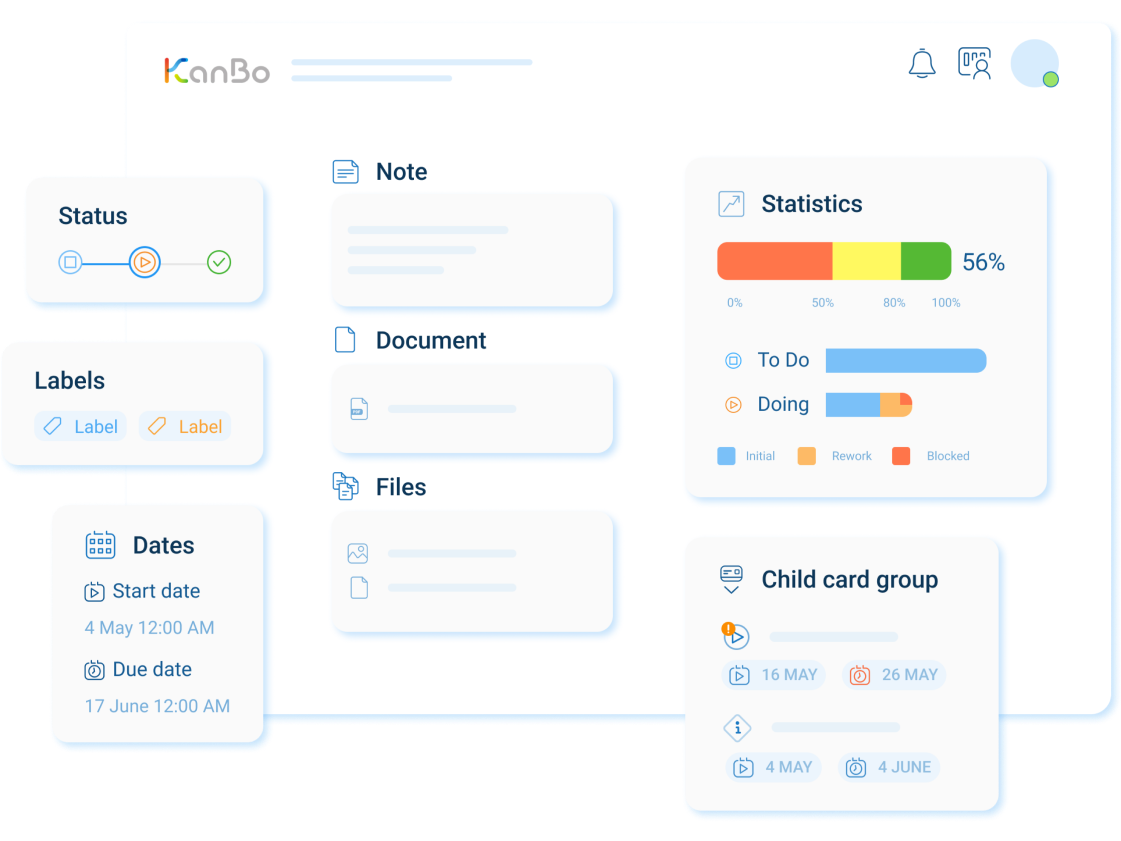
Each engagement runs in its own space carrying its purpose, its requesting business unit and its scope. Six months in, a new joiner reads why it was commissioned rather than asking someone who half remembers.

Responsibility and access
One name, not a team
Every card carries a named Responsible Person and its contributors. Access runs across six permission levels and can be granted to groups, so ownership survives a reorganization instead of being rebuilt after one.

Statuses and priority
Current state, in your own language
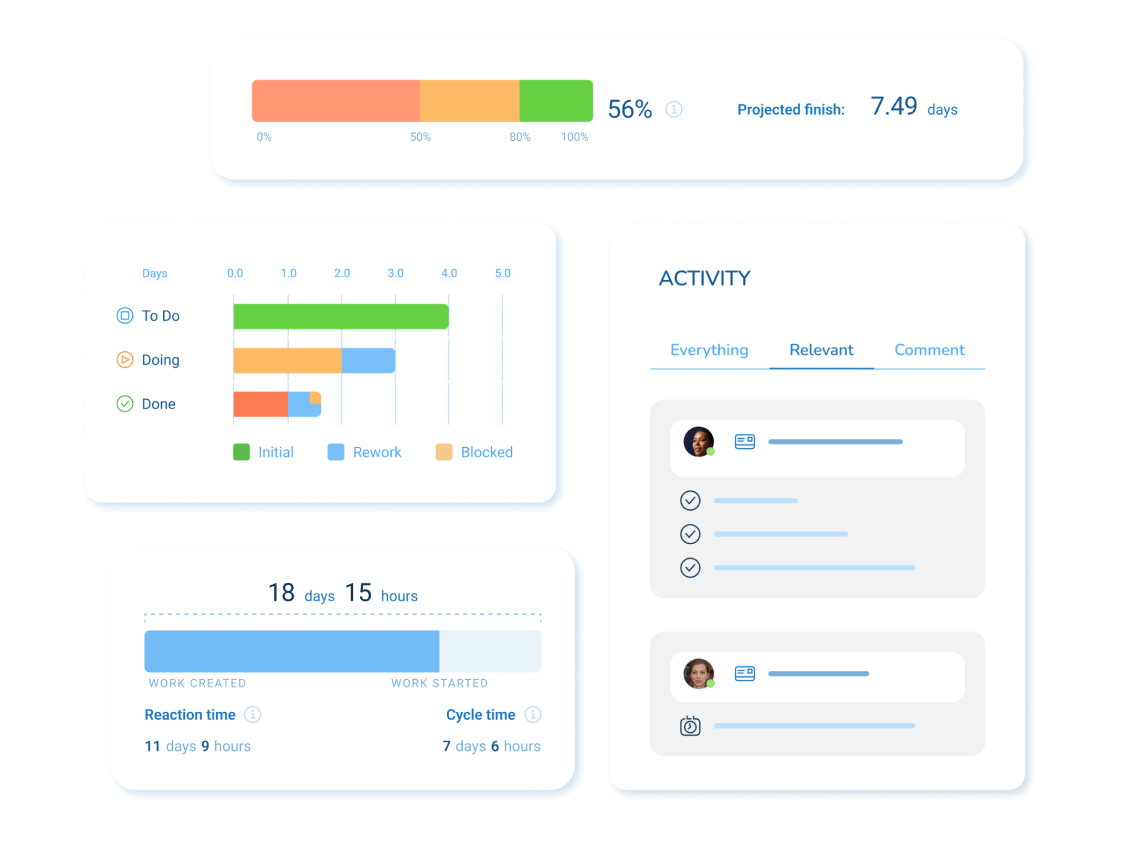
Each space names its own stages, and each is typed — Information, Not started, In progress, Completed, Cancelled — so local vocabulary survives while the portfolio still aggregates. Spaces carry a priority, and views filter to what is overdue or blocked.

Relations and blockers
Including the things you do not control
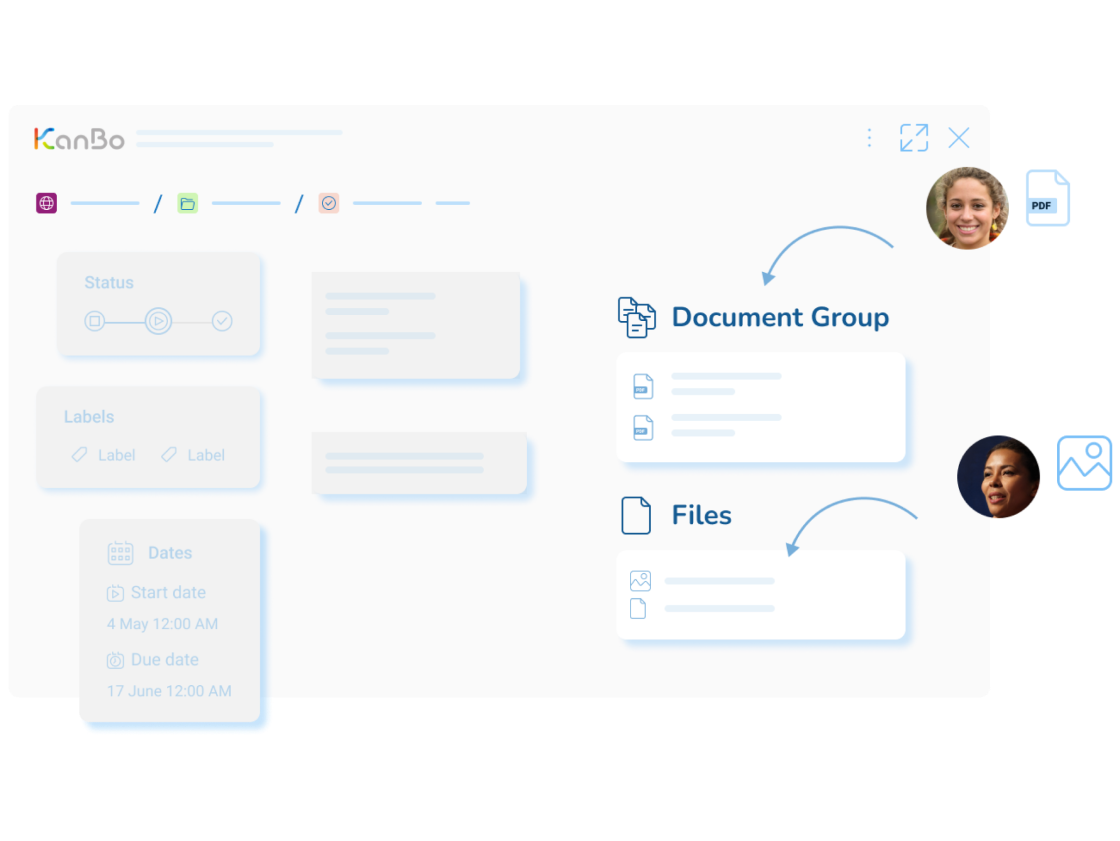
LDependencies are links, and they cross into other departments — a data owner, an access approval, a vendor. A blocker is an object with a reason and a responsible owner, so recurring friction becomes countable rather than repeated.
Day in Life with KanBo
A day in the life of a Deputy General Manager, Data CoE
Step 1 — You start with what you can honestly accept
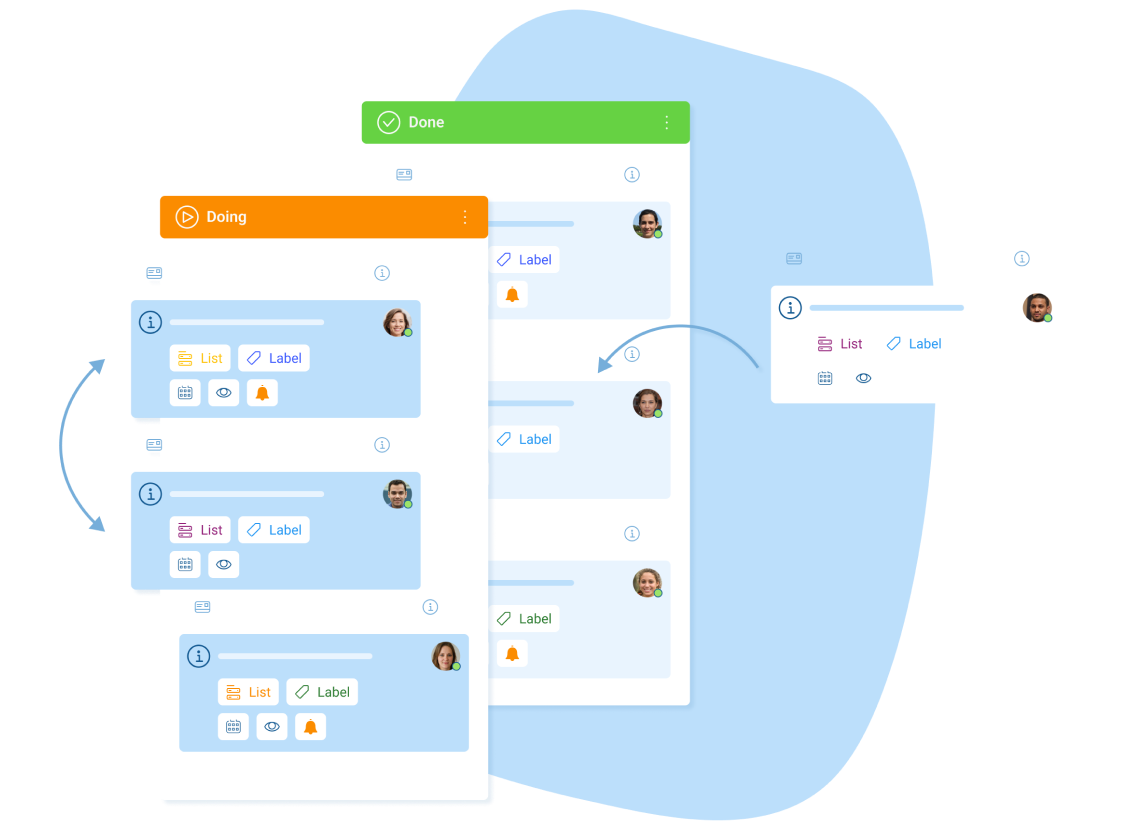
The intake queue shows what business units are asking for, scoped as planned roles rather than as conversations: capability, quantity, effort, dates, nobody named yet. Against it sits real availability — who is committed, who is on leave, who falls outside their contract window, who is already overallocated. “Yes, from the second week of May” replaces “yes” followed by an apology in June.
Step 2 — You spend the day on decisions, not on chasing
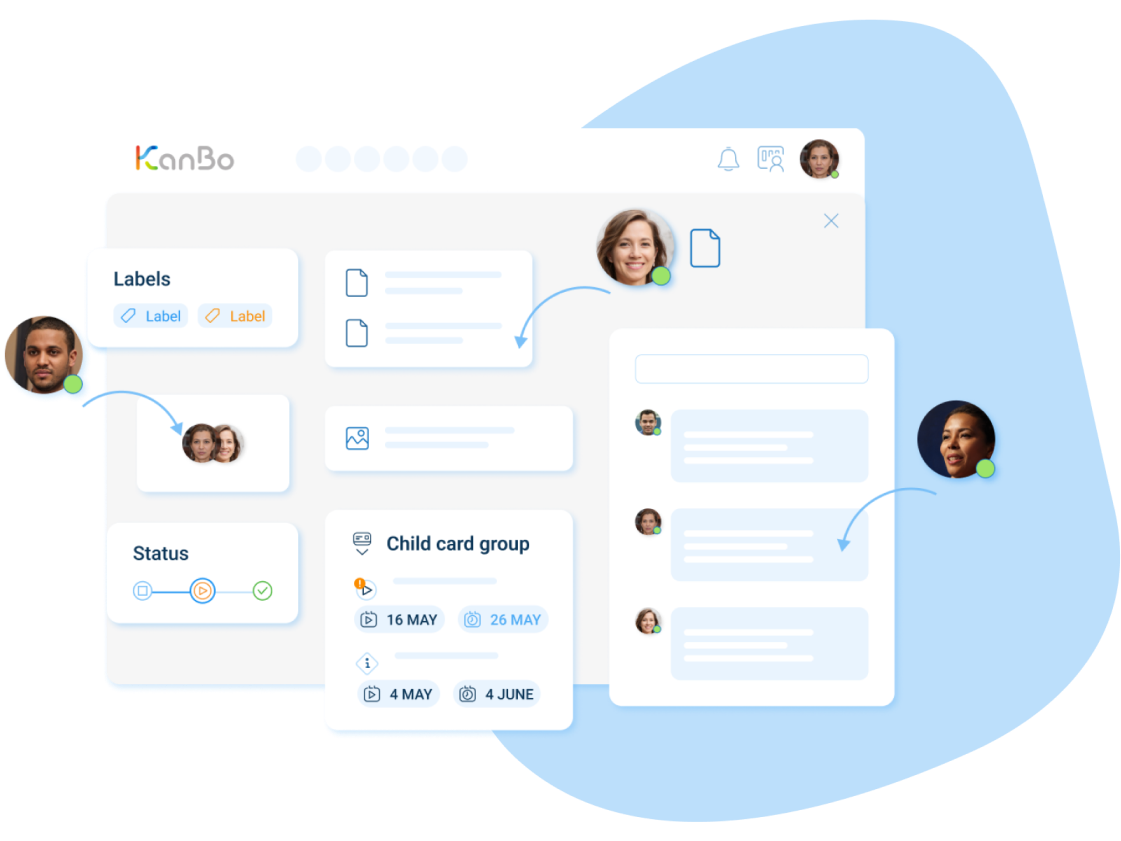
Staffing decisions arrive with their reasoning attached, so the conversation with a delivery lead is about trade-offs rather than about who escalated hardest. What is blocking your teams is named, owned and dated. And an assistant working over MCP can sweep the whole portfolio — what changed, what is at risk, what needs you — under your own permissions, with you deciding what it means.
Step 3 — Reporting is a view, not an exercise
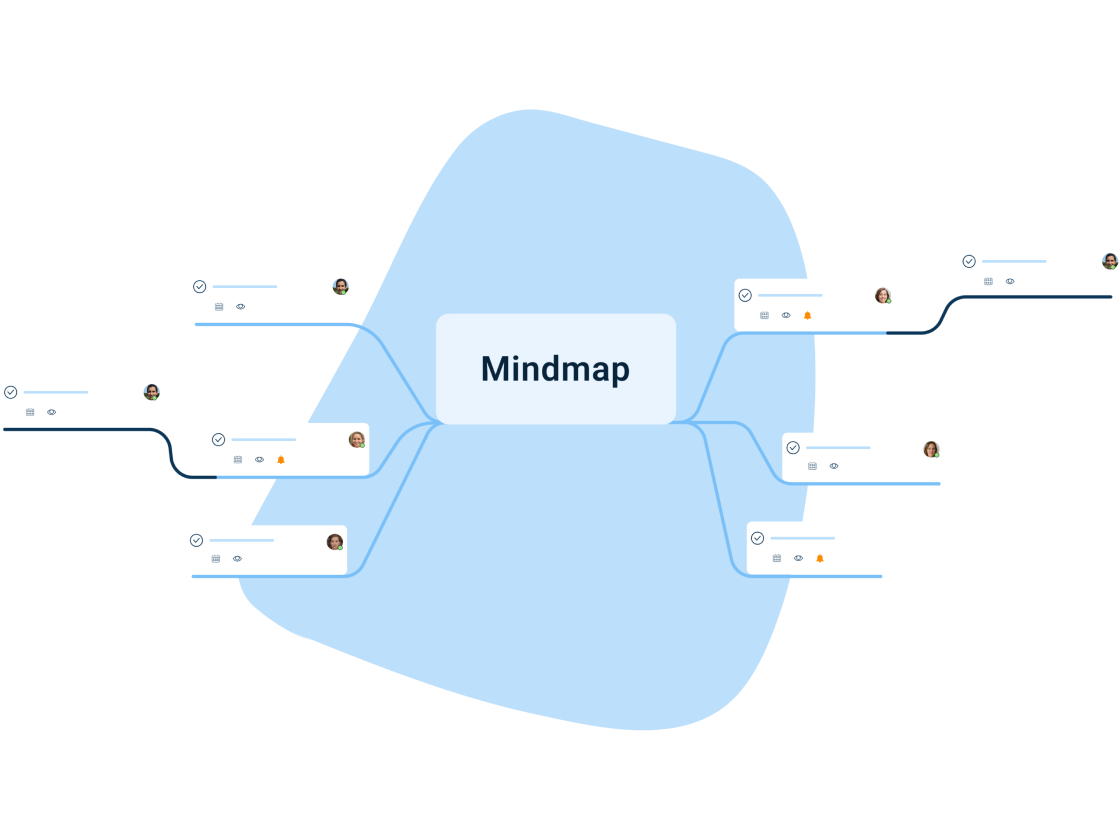
Planned against actual, by person and by period, from the same record the work runs in. Nobody assembles a monthly capacity deck, because the numbers were produced by doing the work rather than by describing it afterwards.
Saying yes is not the same as having capacity
A CoE is under constant pressure to accept everything, and accepting everything feels supportive. It is not, and the reason is arithmetic rather than temperament. John Little’s theorem states it cleanly: in any stable system, the average time something spends inside equals the work in progress divided by the rate at which the system completes work. Take on more concurrent engagements without adding throughput and every one of them takes longer. The CoE does not produce more. It makes everyone wait, and it loses the ability to promise a date to anybody. This is why the second half of the chain matters as much as the first. Knowing what is owned and what depends on what is not enough if you cannot see what capacity exists, what is actually happening, and what has already been proven done.

Capacity and skills
Availability, and why a day is not
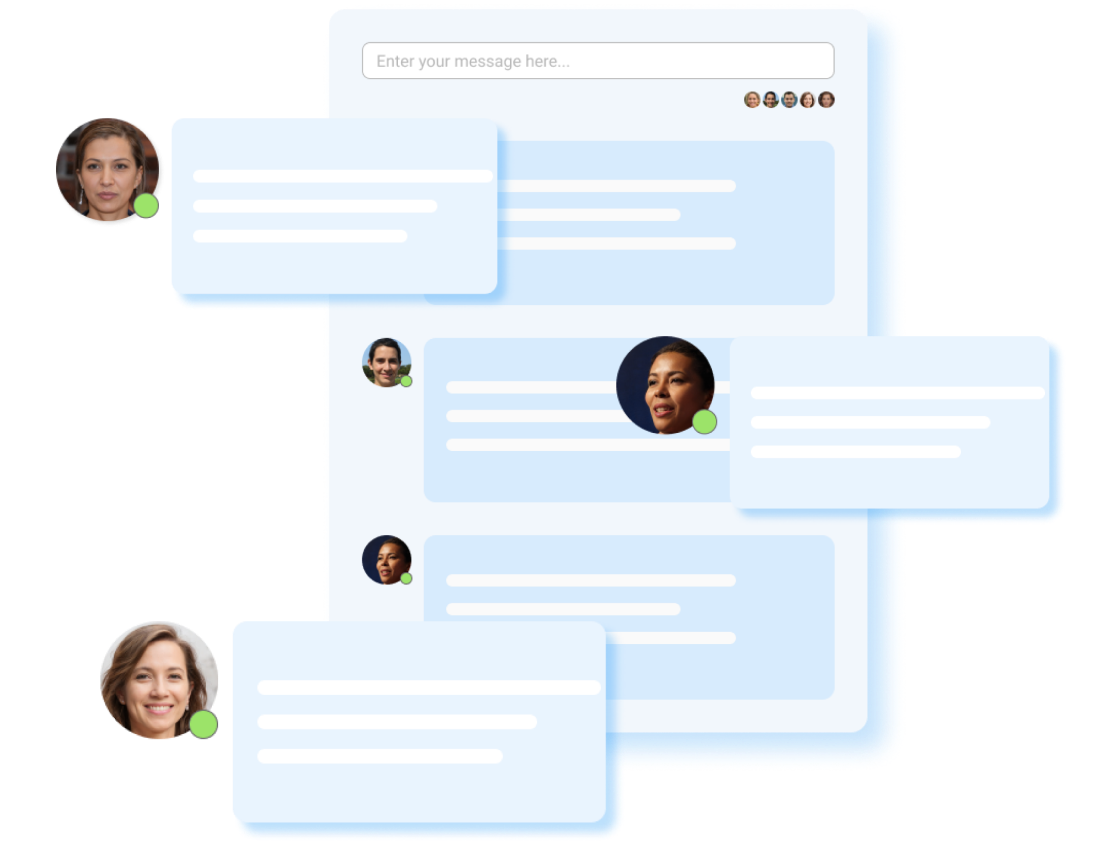
Capacity is computed from work schedules, part-time patterns, leave and location holidays — and the reason a day is unavailable is reported, distinguishing a public holiday from personal leave from an expired contractor.

Allocations and MCP
Both kinds of worker, one record
Allocations show who is committed to what and when. An AI agent connects over MCP under a delegated identity, holding exactly the permissions of the person it works for — visible in the same record, governed by the same rules.

Activity and validation
Including what changed underneath you
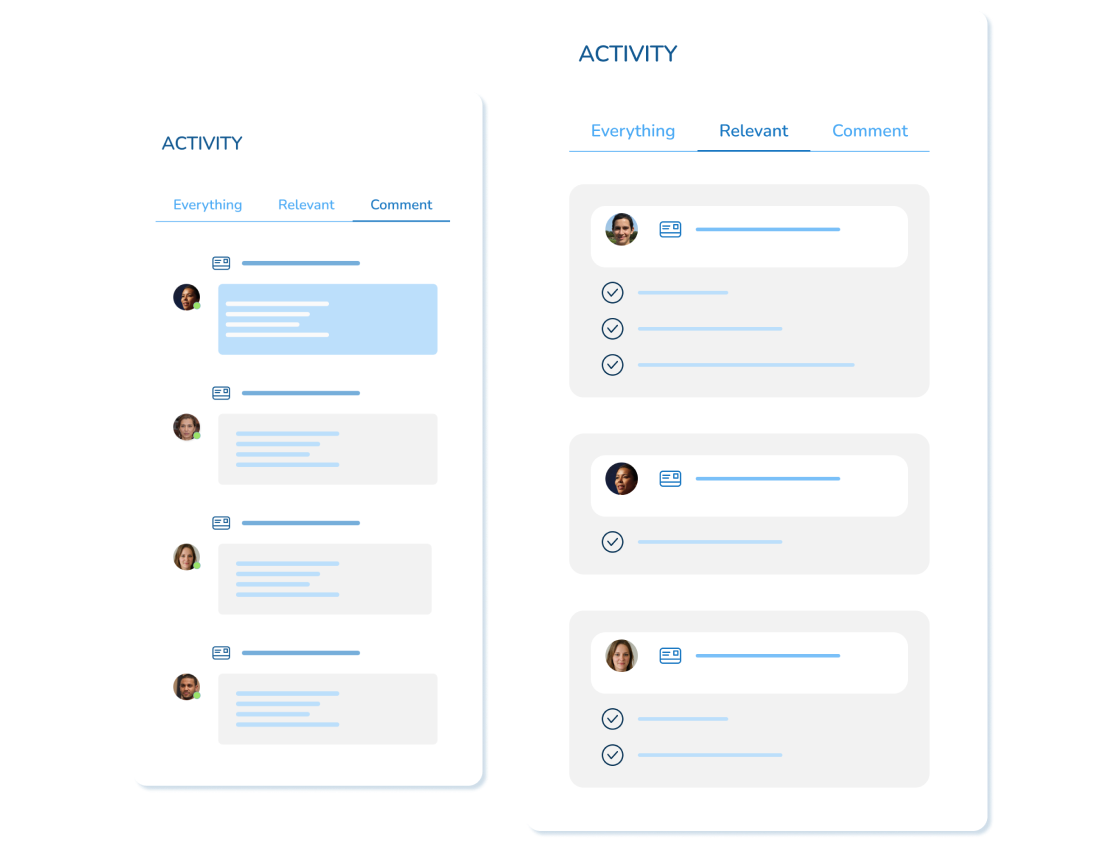
Activity history sits on the card, the space and the person. When a card’s dates move beneath a plan, the allocation is marked invalid rather than drifting silently out of alignment.
Evidence
Decided, delivered, demonstrable
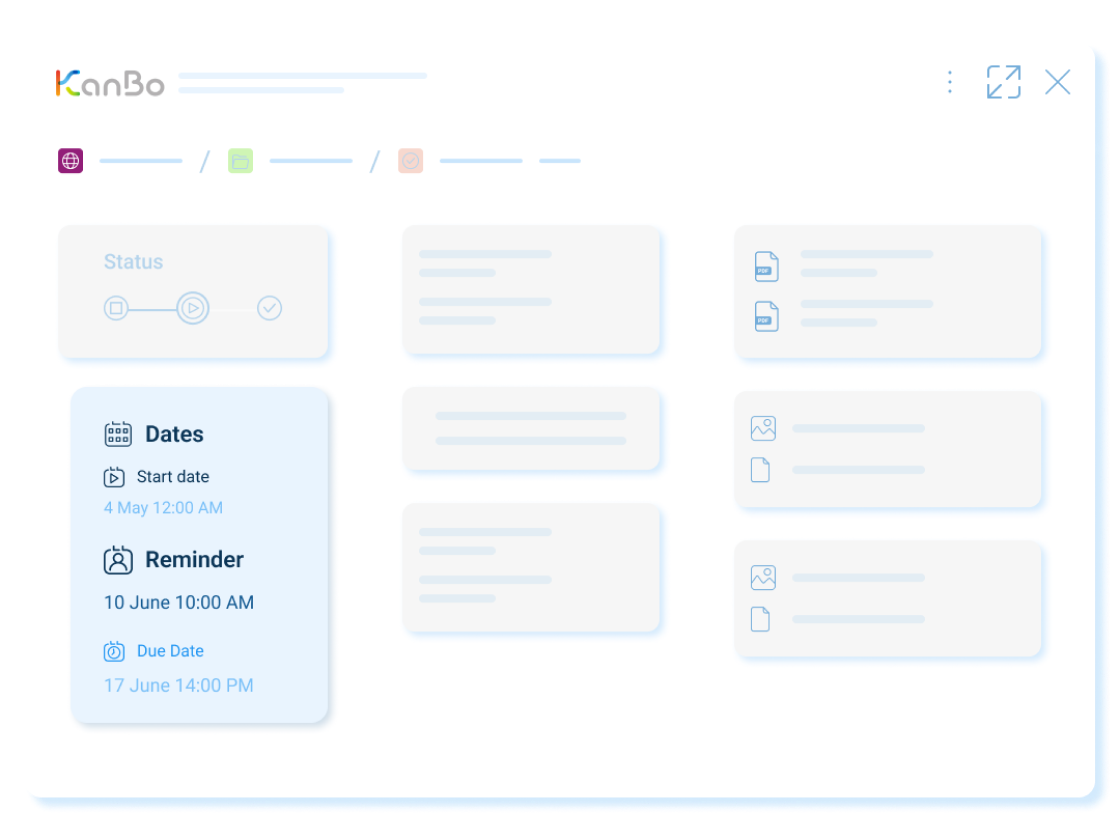
The decision and its reasoning stay on the item that carries it. Deliverables are connected to the repository you already use rather than copied. Time booked against plan shows what the engagement actually consumed.
Get started today with
KanBo!

KanBo is a work coordination software designed to help self-organizing teams work smarter and faster. You can see KanBo in action by accessing our Sandbox demonstration environment.
Q&A
Have a question? We’ve got answers!
Nine things, in order: why work exists, who owns it, what matters now, what depends on what, what resources are available, what humans and agents are doing, what changed, what decision was made, and what output proves completion. Most organizations hold two or three of these in systems and the rest in people. Every link that lives in someone’s head is a link an agent cannot read and a successor cannot inherit.
Both, in one platform, which is the point. The engagement runs as work — spaces, cards, owners, statuses, dependencies, documents — and the people, skills, allocations, utilization and cost sit on the same records under the same permissions. Most organizations run a project tool alongside a separate staffing tool and spend real effort keeping them in agreement. Here there is one record and no reconciliation.
Through planned roles. A planned role is a real object on the work: the capability required, how many resources, how much effort, over which dates — with no name attached. Its state moves from unassigned to partially assigned to assigned as people are matched, and it can be marked not feasible. That separation between demand and assignment is what makes this capacity planning rather than assignment tracking.
With the reasoning the system produced. Candidates are ranked on skill fit, availability and preference, and each result shows which required skills matched, required level against actual, what was exceeded, what failed, and how capacity was covered. Someone missing a required skill is not returned at all. Skill records carry their confidence — self-declared, manager-verified or system-inferred — and their validity dates, so a lapsed certification drops out of matching instead of staying on a spreadsheet.
It is the normal case, and the allocation model assumes it. Capacity is requested rather than taken: a request can be proposed, accepted or rejected, and whether approval is required is a setting per space. Skills, availability and leave live with the person regardless of reporting line, so the picture is complete even when the authority is not yours.
Yes. Resource Management permissions are separate from space permissions, and finance is its own permission area, so a delivery lead can plan, allocate and read utilization without seeing cost or bill rates. Human and non-human resources are separately controlled too. A named set of rates per job role can attach to a business unit or an engagement, so the same role is recharged differently without duplicating anything.
Alongside it. KanBo does not catalogue data, trace lineage or profile quality. It runs the CoE itself — the demand, the capacity, the commitments, the delivery and the evidence — which is the part usually held in spreadsheets even in organizations with excellent data tooling.
Deputy General Manager, Data CoE
A Data Centre of Excellence is measured on delivery and constrained by capacity. Demand arrives from business units that do not report to you. The capability sits with a small number of specialists whose skills are uneven, whose certifications expire, and who are already committed to something else. The daily questions are not analytical. Can we accept this? Who is genuinely available? Does anyone still hold that certification? What did we promise in March, and are we delivering it? Why was one unit’s request prioritised over another’s? None of those are answered by a data platform, and none of them are in a status report. They are answered by organizational context — and KanBo is where that context lives, for the people doing the work and for the agents now working alongside them.
The context a CoE runs on
Ask why a Centre of Excellence stalls and the answer is rarely capability. It is that nobody can see the whole picture at once — so commitments are made without capacity, priorities are set by whoever escalated last, and the reasoning behind a staffing decision disappears the moment it is made. KanBo supplies the missing organizational context, as a chain rather than a dashboard: why work exists → who owns it → what matters now → what depends on what → what resources are available → what humans and agents are doing → what changed → what decision was made → what output proves completion. Break any link and the ones after it become guesswork. A CoE that holds all nine can answer the intake question honestly, which is the only question that matters at the front of the process.
Evidence
The reason, attached to the work
Each engagement runs in its own space carrying its purpose, its requesting business unit and its scope. Six months in, a new joiner reads why it was commissioned rather than asking someone who half remembers.
Responsibility and access
One name, not a team
Every card carries a named Responsible Person and its contributors. Access runs across six permission levels and can be granted to groups, so ownership survives a reorganization instead of being rebuilt after one.
Statuses and priority
Current state, in your own language
Each space names its own stages, and each is typed — Information, Not started, In progress, Completed, Cancelled — so local vocabulary survives while the portfolio still aggregates. Spaces carry a priority, and views filter to what is overdue or blocked.
Relations and blockers
Including the things you do not control
LDependencies are links, and they cross into other departments — a data owner, an access approval, a vendor. A blocker is an object with a reason and a responsible owner, so recurring friction becomes countable rather than repeated.
Day in Life with KanBo
A day in the life of a Deputy General Manager, Data CoE
Step 1 — You start with what you can honestly accept
The intake queue shows what business units are asking for, scoped as planned roles rather than as conversations: capability, quantity, effort, dates, nobody named yet. Against it sits real availability — who is committed, who is on leave, who falls outside their contract window, who is already overallocated. “Yes, from the second week of May” replaces “yes” followed by an apology in June.
Step 2 — You spend the day on decisions, not on chasing
Staffing decisions arrive with their reasoning attached, so the conversation with a delivery lead is about trade-offs rather than about who escalated hardest. What is blocking your teams is named, owned and dated. And an assistant working over MCP can sweep the whole portfolio — what changed, what is at risk, what needs you — under your own permissions, with you deciding what it means.
Step 3 — Reporting is a view, not an exercise
Planned against actual, by person and by period, from the same record the work runs in. Nobody assembles a monthly capacity deck, because the numbers were produced by doing the work rather than by describing it afterwards.
Saying yes is not the same as having capacity
A CoE is under constant pressure to accept everything, and accepting everything feels supportive. It is not, and the reason is arithmetic rather than temperament. John Little’s theorem states it cleanly: in any stable system, the average time something spends inside equals the work in progress divided by the rate at which the system completes work. Take on more concurrent engagements without adding throughput and every one of them takes longer. The CoE does not produce more. It makes everyone wait, and it loses the ability to promise a date to anybody. This is why the second half of the chain matters as much as the first. Knowing what is owned and what depends on what is not enough if you cannot see what capacity exists, what is actually happening, and what has already been proven done.
Capacity and skills
Availability, and why a day is not
Capacity is computed from work schedules, part-time patterns, leave and location holidays — and the reason a day is unavailable is reported, distinguishing a public holiday from personal leave from an expired contractor.
Allocations and MCP
Both kinds of worker, one record
Allocations show who is committed to what and when. An AI agent connects over MCP under a delegated identity, holding exactly the permissions of the person it works for — visible in the same record, governed by the same rules.
Activity and validation
Including what changed underneath you
Activity history sits on the card, the space and the person. When a card’s dates move beneath a plan, the allocation is marked invalid rather than drifting silently out of alignment.
Evidence
Decided, delivered, demonstrable
The decision and its reasoning stay on the item that carries it. Deliverables are connected to the repository you already use rather than copied. Time booked against plan shows what the engagement actually consumed.
Get started today with KanBo!
KanBo is a work coordination software designed to help self-organizing teams work smarter and faster. You can see KanBo in action by accessing our Sandbox demonstration environment.
Q&A
Have a question? We’ve got answers!
Nine things, in order: why work exists, who owns it, what matters now, what depends on what, what resources are available, what humans and agents are doing, what changed, what decision was made, and what output proves completion. Most organizations hold two or three of these in systems and the rest in people. Every link that lives in someone’s head is a link an agent cannot read and a successor cannot inherit.
Both, in one platform, which is the point. The engagement runs as work — spaces, cards, owners, statuses, dependencies, documents — and the people, skills, allocations, utilization and cost sit on the same records under the same permissions. Most organizations run a project tool alongside a separate staffing tool and spend real effort keeping them in agreement. Here there is one record and no reconciliation.
Through planned roles. A planned role is a real object on the work: the capability required, how many resources, how much effort, over which dates — with no name attached. Its state moves from unassigned to partially assigned to assigned as people are matched, and it can be marked not feasible. That separation between demand and assignment is what makes this capacity planning rather than assignment tracking.
With the reasoning the system produced. Candidates are ranked on skill fit, availability and preference, and each result shows which required skills matched, required level against actual, what was exceeded, what failed, and how capacity was covered. Someone missing a required skill is not returned at all. Skill records carry their confidence — self-declared, manager-verified or system-inferred — and their validity dates, so a lapsed certification drops out of matching instead of staying on a spreadsheet.
It is the normal case, and the allocation model assumes it. Capacity is requested rather than taken: a request can be proposed, accepted or rejected, and whether approval is required is a setting per space. Skills, availability and leave live with the person regardless of reporting line, so the picture is complete even when the authority is not yours.
Yes. Resource Management permissions are separate from space permissions, and finance is its own permission area, so a delivery lead can plan, allocate and read utilization without seeing cost or bill rates. Human and non-human resources are separately controlled too. A named set of rates per job role can attach to a business unit or an engagement, so the same role is recharged differently without duplicating anything.
Alongside it. KanBo does not catalogue data, trace lineage or profile quality. It runs the CoE itself — the demand, the capacity, the commitments, the delivery and the evidence — which is the part usually held in spreadsheets even in organizations with excellent data tooling.
Deputy General Manager, Data CoE
A Data Centre of Excellence is measured on delivery and constrained by capacity. Demand arrives from business units that do not report to you. The capability sits with a small number of specialists whose skills are uneven, whose certifications expire, and who are already committed to something else. The daily questions are not analytical. Can we accept this? Who is genuinely available? Does anyone still hold that certification? What did we promise in March, and are we delivering it? Why was one unit’s request prioritised over another’s? None of those are answered by a data platform, and none of them are in a status report. They are answered by organizational context — and KanBo is where that context lives, for the people doing the work and for the agents now working alongside them.
The context a CoE runs on
Ask why a Centre of Excellence stalls and the answer is rarely capability. It is that nobody can see the whole picture at once — so commitments are made without capacity, priorities are set by whoever escalated last, and the reasoning behind a staffing decision disappears the moment it is made. KanBo supplies the missing organizational context, as a chain rather than a dashboard: why work exists → who owns it → what matters now → what depends on what → what resources are available → what humans and agents are doing → what changed → what decision was made → what output proves completion. Break any link and the ones after it become guesswork. A CoE that holds all nine can answer the intake question honestly, which is the only question that matters at the front of the process.
Evidence
The reason, attached to the work
Each engagement runs in its own space carrying its purpose, its requesting business unit and its scope. Six months in, a new joiner reads why it was commissioned rather than asking someone who half remembers.
Responsibility and access
One name, not a team
Every card carries a named Responsible Person and its contributors. Access runs across six permission levels and can be granted to groups, so ownership survives a reorganization instead of being rebuilt after one.
Statuses and priority
Current state, in your own language
Each space names its own stages, and each is typed — Information, Not started, In progress, Completed, Cancelled — so local vocabulary survives while the portfolio still aggregates. Spaces carry a priority, and views filter to what is overdue or blocked.
Relations and blockers
Including the things you do not control
LDependencies are links, and they cross into other departments — a data owner, an access approval, a vendor. A blocker is an object with a reason and a responsible owner, so recurring friction becomes countable rather than repeated.
Day in Life with KanBo
A day in the life of a Deputy General Manager, Data CoE
Step 1 — You start with what you can honestly accept
The intake queue shows what business units are asking for, scoped as planned roles rather than as conversations: capability, quantity, effort, dates, nobody named yet. Against it sits real availability — who is committed, who is on leave, who falls outside their contract window, who is already overallocated. “Yes, from the second week of May” replaces “yes” followed by an apology in June.
Step 2 — You spend the day on decisions, not on chasing
Staffing decisions arrive with their reasoning attached, so the conversation with a delivery lead is about trade-offs rather than about who escalated hardest. What is blocking your teams is named, owned and dated. And an assistant working over MCP can sweep the whole portfolio — what changed, what is at risk, what needs you — under your own permissions, with you deciding what it means.
Step 3 — Reporting is a view, not an exercise
Planned against actual, by person and by period, from the same record the work runs in. Nobody assembles a monthly capacity deck, because the numbers were produced by doing the work rather than by describing it afterwards.
Saying yes is not the same as having capacity
A CoE is under constant pressure to accept everything, and accepting everything feels supportive. It is not, and the reason is arithmetic rather than temperament. John Little’s theorem states it cleanly: in any stable system, the average time something spends inside equals the work in progress divided by the rate at which the system completes work. Take on more concurrent engagements without adding throughput and every one of them takes longer. The CoE does not produce more. It makes everyone wait, and it loses the ability to promise a date to anybody. This is why the second half of the chain matters as much as the first. Knowing what is owned and what depends on what is not enough if you cannot see what capacity exists, what is actually happening, and what has already been proven done.
Capacity and skills
Availability, and why a day is not
Capacity is computed from work schedules, part-time patterns, leave and location holidays — and the reason a day is unavailable is reported, distinguishing a public holiday from personal leave from an expired contractor.
Allocations and MCP
Both kinds of worker, one record
Allocations show who is committed to what and when. An AI agent connects over MCP under a delegated identity, holding exactly the permissions of the person it works for — visible in the same record, governed by the same rules.
Activity and validation
Including what changed underneath you
Activity history sits on the card, the space and the person. When a card’s dates move beneath a plan, the allocation is marked invalid rather than drifting silently out of alignment.
Evidence
Decided, delivered, demonstrable
The decision and its reasoning stay on the item that carries it. Deliverables are connected to the repository you already use rather than copied. Time booked against plan shows what the engagement actually consumed.
Get started today with KanBo!
KanBo is a work coordination software designed to help self-organizing teams work smarter and faster. You can see KanBo in action by accessing our Sandbox demonstration environment.
Q&A
Have a question? We’ve got answers!
Nine things, in order: why work exists, who owns it, what matters now, what depends on what, what resources are available, what humans and agents are doing, what changed, what decision was made, and what output proves completion. Most organizations hold two or three of these in systems and the rest in people. Every link that lives in someone’s head is a link an agent cannot read and a successor cannot inherit.
Both, in one platform, which is the point. The engagement runs as work — spaces, cards, owners, statuses, dependencies, documents — and the people, skills, allocations, utilization and cost sit on the same records under the same permissions. Most organizations run a project tool alongside a separate staffing tool and spend real effort keeping them in agreement. Here there is one record and no reconciliation.
Through planned roles. A planned role is a real object on the work: the capability required, how many resources, how much effort, over which dates — with no name attached. Its state moves from unassigned to partially assigned to assigned as people are matched, and it can be marked not feasible. That separation between demand and assignment is what makes this capacity planning rather than assignment tracking.
With the reasoning the system produced. Candidates are ranked on skill fit, availability and preference, and each result shows which required skills matched, required level against actual, what was exceeded, what failed, and how capacity was covered. Someone missing a required skill is not returned at all. Skill records carry their confidence — self-declared, manager-verified or system-inferred — and their validity dates, so a lapsed certification drops out of matching instead of staying on a spreadsheet.
It is the normal case, and the allocation model assumes it. Capacity is requested rather than taken: a request can be proposed, accepted or rejected, and whether approval is required is a setting per space. Skills, availability and leave live with the person regardless of reporting line, so the picture is complete even when the authority is not yours.
Yes. Resource Management permissions are separate from space permissions, and finance is its own permission area, so a delivery lead can plan, allocate and read utilization without seeing cost or bill rates. Human and non-human resources are separately controlled too. A named set of rates per job role can attach to a business unit or an engagement, so the same role is recharged differently without duplicating anything.
Alongside it. KanBo does not catalogue data, trace lineage or profile quality. It runs the CoE itself — the demand, the capacity, the commitments, the delivery and the evidence — which is the part usually held in spreadsheets even in organizations with excellent data tooling.
Deputy General Manager, Data CoE
A Data Centre of Excellence is measured on delivery and constrained by capacity. Demand arrives from business units that do not report to you. The capability sits with a small number of specialists whose skills are uneven, whose certifications expire, and who are already committed to something else. The daily questions are not analytical. Can we accept this? Who is genuinely available? Does anyone still hold that certification? What did we promise in March, and are we delivering it? Why was one unit’s request prioritised over another’s? None of those are answered by a data platform, and none of them are in a status report. They are answered by organizational context — and KanBo is where that context lives, for the people doing the work and for the agents now working alongside them.
The context a CoE runs on
Ask why a Centre of Excellence stalls and the answer is rarely capability. It is that nobody can see the whole picture at once — so commitments are made without capacity, priorities are set by whoever escalated last, and the reasoning behind a staffing decision disappears the moment it is made. KanBo supplies the missing organizational context, as a chain rather than a dashboard: why work exists → who owns it → what matters now → what depends on what → what resources are available → what humans and agents are doing → what changed → what decision was made → what output proves completion. Break any link and the ones after it become guesswork. A CoE that holds all nine can answer the intake question honestly, which is the only question that matters at the front of the process.
Evidence
The reason, attached to the work
Each engagement runs in its own space carrying its purpose, its requesting business unit and its scope. Six months in, a new joiner reads why it was commissioned rather than asking someone who half remembers.
Responsibility and access
One name, not a team
Every card carries a named Responsible Person and its contributors. Access runs across six permission levels and can be granted to groups, so ownership survives a reorganization instead of being rebuilt after one.
Statuses and priority
Current state, in your own language
Each space names its own stages, and each is typed — Information, Not started, In progress, Completed, Cancelled — so local vocabulary survives while the portfolio still aggregates. Spaces carry a priority, and views filter to what is overdue or blocked.
Relations and blockers
Including the things you do not control
LDependencies are links, and they cross into other departments — a data owner, an access approval, a vendor. A blocker is an object with a reason and a responsible owner, so recurring friction becomes countable rather than repeated.
Day in Life with KanBo
A day in the life of a Deputy General Manager, Data CoE
Step 1 — You start with what you can honestly accept
The intake queue shows what business units are asking for, scoped as planned roles rather than as conversations: capability, quantity, effort, dates, nobody named yet. Against it sits real availability — who is committed, who is on leave, who falls outside their contract window, who is already overallocated. “Yes, from the second week of May” replaces “yes” followed by an apology in June.
Step 2 — You spend the day on decisions, not on chasing
Staffing decisions arrive with their reasoning attached, so the conversation with a delivery lead is about trade-offs rather than about who escalated hardest. What is blocking your teams is named, owned and dated. And an assistant working over MCP can sweep the whole portfolio — what changed, what is at risk, what needs you — under your own permissions, with you deciding what it means.
Step 3 — Reporting is a view, not an exercise
Planned against actual, by person and by period, from the same record the work runs in. Nobody assembles a monthly capacity deck, because the numbers were produced by doing the work rather than by describing it afterwards.
Saying yes is not the same as having capacity
A CoE is under constant pressure to accept everything, and accepting everything feels supportive. It is not, and the reason is arithmetic rather than temperament. John Little’s theorem states it cleanly: in any stable system, the average time something spends inside equals the work in progress divided by the rate at which the system completes work. Take on more concurrent engagements without adding throughput and every one of them takes longer. The CoE does not produce more. It makes everyone wait, and it loses the ability to promise a date to anybody. This is why the second half of the chain matters as much as the first. Knowing what is owned and what depends on what is not enough if you cannot see what capacity exists, what is actually happening, and what has already been proven done.
Capacity and skills
Availability, and why a day is not
Capacity is computed from work schedules, part-time patterns, leave and location holidays — and the reason a day is unavailable is reported, distinguishing a public holiday from personal leave from an expired contractor.
Allocations and MCP
Both kinds of worker, one record
Allocations show who is committed to what and when. An AI agent connects over MCP under a delegated identity, holding exactly the permissions of the person it works for — visible in the same record, governed by the same rules.
Activity and validation
Including what changed underneath you
Activity history sits on the card, the space and the person. When a card’s dates move beneath a plan, the allocation is marked invalid rather than drifting silently out of alignment.
Evidence
Decided, delivered, demonstrable
The decision and its reasoning stay on the item that carries it. Deliverables are connected to the repository you already use rather than copied. Time booked against plan shows what the engagement actually consumed.
Get started today with KanBo!
KanBo is a work coordination software designed to help self-organizing teams work smarter and faster. You can see KanBo in action by accessing our Sandbox demonstration environment.
Q&A
Have a question? We’ve got answers!
Nine things, in order: why work exists, who owns it, what matters now, what depends on what, what resources are available, what humans and agents are doing, what changed, what decision was made, and what output proves completion. Most organizations hold two or three of these in systems and the rest in people. Every link that lives in someone’s head is a link an agent cannot read and a successor cannot inherit.
Both, in one platform, which is the point. The engagement runs as work — spaces, cards, owners, statuses, dependencies, documents — and the people, skills, allocations, utilization and cost sit on the same records under the same permissions. Most organizations run a project tool alongside a separate staffing tool and spend real effort keeping them in agreement. Here there is one record and no reconciliation.
Through planned roles. A planned role is a real object on the work: the capability required, how many resources, how much effort, over which dates — with no name attached. Its state moves from unassigned to partially assigned to assigned as people are matched, and it can be marked not feasible. That separation between demand and assignment is what makes this capacity planning rather than assignment tracking.
With the reasoning the system produced. Candidates are ranked on skill fit, availability and preference, and each result shows which required skills matched, required level against actual, what was exceeded, what failed, and how capacity was covered. Someone missing a required skill is not returned at all. Skill records carry their confidence — self-declared, manager-verified or system-inferred — and their validity dates, so a lapsed certification drops out of matching instead of staying on a spreadsheet.
It is the normal case, and the allocation model assumes it. Capacity is requested rather than taken: a request can be proposed, accepted or rejected, and whether approval is required is a setting per space. Skills, availability and leave live with the person regardless of reporting line, so the picture is complete even when the authority is not yours.
Yes. Resource Management permissions are separate from space permissions, and finance is its own permission area, so a delivery lead can plan, allocate and read utilization without seeing cost or bill rates. Human and non-human resources are separately controlled too. A named set of rates per job role can attach to a business unit or an engagement, so the same role is recharged differently without duplicating anything.
Alongside it. KanBo does not catalogue data, trace lineage or profile quality. It runs the CoE itself — the demand, the capacity, the commitments, the delivery and the evidence — which is the part usually held in spreadsheets even in organizations with excellent data tooling.