

Flexible Work
KanBo is adopted at organization level. The organization decides how it is deployed, how access is governed and what stays standard across it — and inside that frame, departments and teams shape their own work around the processes they actually run rather than around the shape of a tool. Projects, workflows, documents, communication, responsibilities and dependencies take the form the work requires, and stay connected across the whole organization while they change.
Flexibility is not a convenience. Conditions change faster than organizations can redesign themselves: new regulation, new suppliers, a reorganization, a process that has to run differently next quarter. Organizations answer with remote and hybrid working, leaner structures, cross-functional teams and faster decisions — and every one of those answers depends on being able to reshape how work is coordinated without a migration project. That is what keeps an organization relevant instead of running a model it has outgrown. Self-organizing teams adapt their spaces, views, statuses and cards to their daily reality without losing shared context, governance or the connection to larger business goals. The structure changes; the record does not restart.
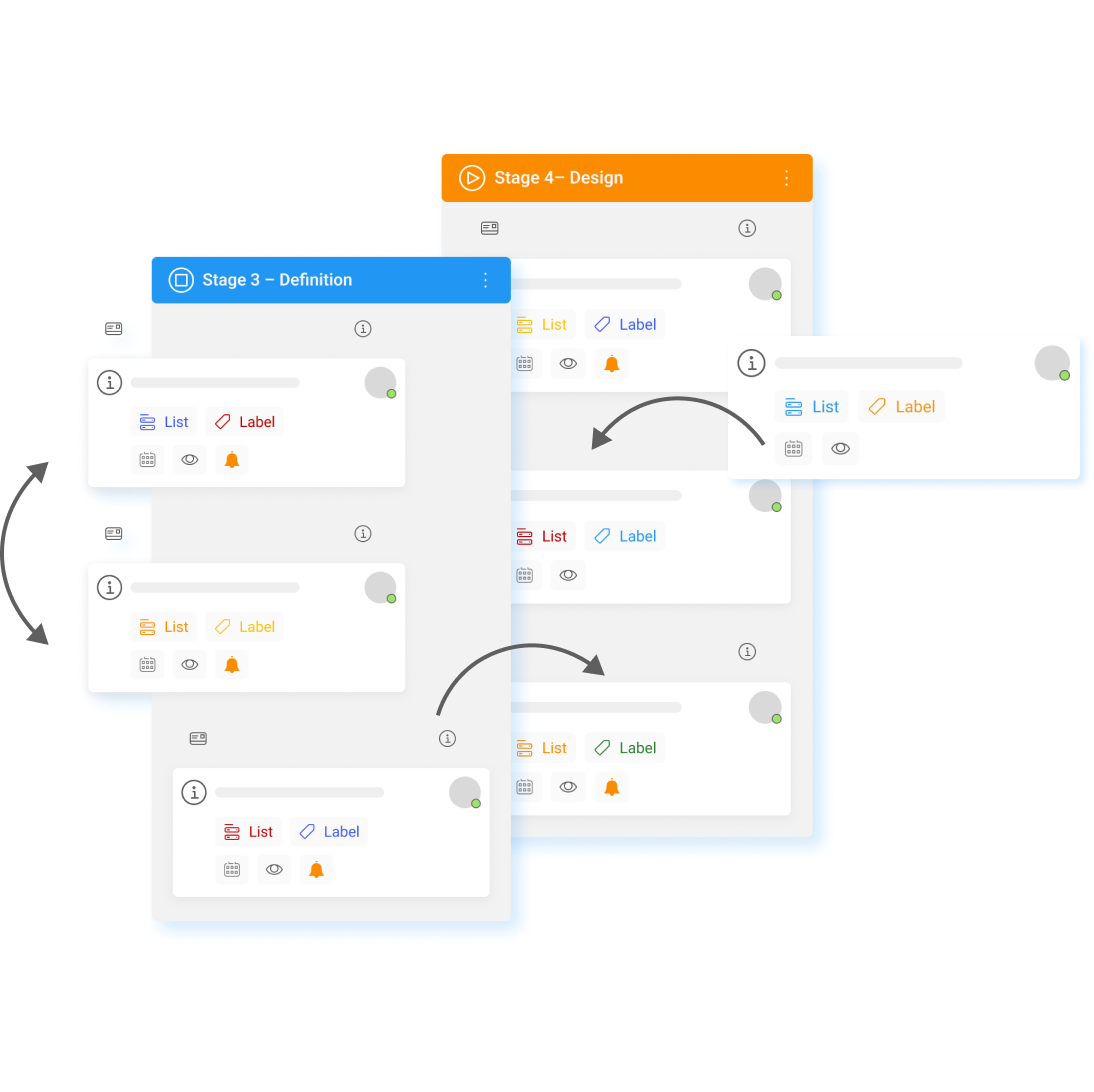
Flexible work without losing control
Flexible work takes two practical forms in most organizations. Remote and hybrid working: people no longer share a room, a corridor or a schedule, so coordination that used to happen by proximity has to happen somewhere explicit. And the lean organization: fewer layers, faster decisions, cross-functional teams assembled around a problem rather than an org chart. Both work only if the record keeps up with them. A third form underneath decides whether either holds — the coordination structure itself has to be changeable. In KanBo each team uses the structure, view, workflow, documents, roles and planning approach that fits its work, while the organization keeps alignment, visibility and governance across every space. The same cards serve the team's daily execution and the executive's portfolio view; only the lens changes. That is what makes adaptation cheap. When conditions change, a team reshapes how it works inside KanBo rather than negotiating a new tool, and the work's history, ownership and dependencies carry forward intact. Flexibility without that layer is merely absence of structure, which fails at scale: the organization loses sight of its own work.
Manager's question
When the work changes shape, does anyone still know who owns what?
KanBo makes responsibility explicit rather than assumed. Each card has a Responsible Person and Co-Workers; access runs across six permission levels — none, reader, visitor, member, owner, super — and can be granted to groups that contain other groups, so a reorganization changes membership rather than requiring the structure to be rebuilt. Spaces are private or shared, and closed, open to self-join, or open by request, so a team decides how open its work is without central administration.
The flexibility that matters here is not fewer roles. It is that ownership can move between people, teams and departments while the work stays in place, with its history and dependencies attached. That is what makes a lean, cross-functional team practical rather than aspirational: a group drawn from four departments works in one shared space, mirror cards put the same card in front of every team that needs it without duplicating it, and colleagues who only follow along get reader or visitor access instead of being copied into email. When the problem is solved the team dissolves and the record stays.
Oliver Hart and Bengt Holmström's Nobel-recognized work on incomplete contracts explains why this is the right design. No agreement can specify in advance everything that will need deciding; what governs behaviour is who holds the decision right when the unforeseen arrives. KanBo puts those rights on the work itself rather than in an org chart describing last year's structure.
Benefit: the right people are involved at the right level of responsibility, and ownership can change without the work being rebuilt.
Manager's question
How do we let teams adapt locally without the organization drifting apart?
KanBo connects daily execution to broader priorities through structure rather than reporting. Cards carry parent/child and predecessor/successor relations, each with a cross-space variant — so a card in one space can be the predecessor of a card in another, and a portfolio view reflects real dependencies between departments rather than a maintained summary. Labels, custom fields and configurable views group the same work by programme, department, owner or goal, depending on who is asking.
Local adaptation stops being a risk once the connections survive it: a team changes how it works without disconnecting from the initiative it belongs to.
James March's distinction between exploitation and exploration is the frame. Organizations that only exploit what already works become highly efficient at something that has stopped mattering; those that only explore compound nothing. Holding both at once requires teams free to work differently while remaining legible to the level above.
Benefit: teams adapt in execution while their work stays connected to the organization's direction.
Manager's question
Does our tool require every process to look the same, when our processes plainly do not
Each space reflects the process it actually supports. Statuses are defined per space — name, colour and order — and each is assigned a type: Information, Not started, In progress, Completed or Cancelled. That one mechanism is what makes local vocabulary safe. A sales space can run Prospecting → Discovery → Proposal → Negotiation → Closed Won while progress and rollups keep working, because each local name is anchored to a type the platform understands.
Everything follows that principle. Cards hold typed elements — notes, checklists, document lists, document folders and sub-card groups — so a card grows with the work instead of being migrated when it outgrows a form, and a checklist item can be promoted into a full card without retyping. Custom fields come in text, number, date and select types, spaces define their own date fields beyond start and due, and automation rules are set by the space owner and can be paused rather than deleted.
W. Ross Ashby's law of requisite variety states the constraint precisely: only variety can absorb variety. A control system needs at least as many responses as the system it governs has states. A single mandated template has far less variety than the work it must cover — which is why the gap reappears as spreadsheets, side channels and shadow tools.
Benefit: processes fit the work, instead of the work being reshaped to fit the software.
Manager's question
Can leadership get clarity without standardizing teams into uniformity
The same cards support ten views — Kanban, List, Table, Calendar, Timeline, Gantt, Mind Map, Workload, Forecast Chart and Time Chart — and each is configurable rather than fixed. Work can be grouped by list, user, status, label, due date, role, space or custom field, coloured and sorted to the question being asked, with the timeline scaled to days, weeks or months. A team lead and an executive read one set of facts from two altitudes.
Risk surfaces through those same lenses rather than in a separate report. A view can be filtered on whether a card is blocked, whether KanBo has detected a conflict between its dates and its relations, how old it is, who is responsible and how its deadlines fall — overdue, today, this week, next week, later. A leader builds the question they need instead of reading what a fixed dashboard decided to show. Blockers are managed objects with a name, a reason and a responsible owner, and can be defined once and reused across the instance, so recurring friction — waiting on legal review, a vendor SLA — becomes something the organization counts rather than mentions.
This is Stafford Beer's Viable System Model in ordinary use. A viable organization gives its operating units real autonomy and keeps cohesion by attenuating what flows upward: management sees the variety it must act on, not everything the units do. Asking every team to work identically so leadership can read one report is the opposite design, and it destroys the adaptability it was meant to control.
Benefit: managers gain control through transparency rather than through standardization or status requests.
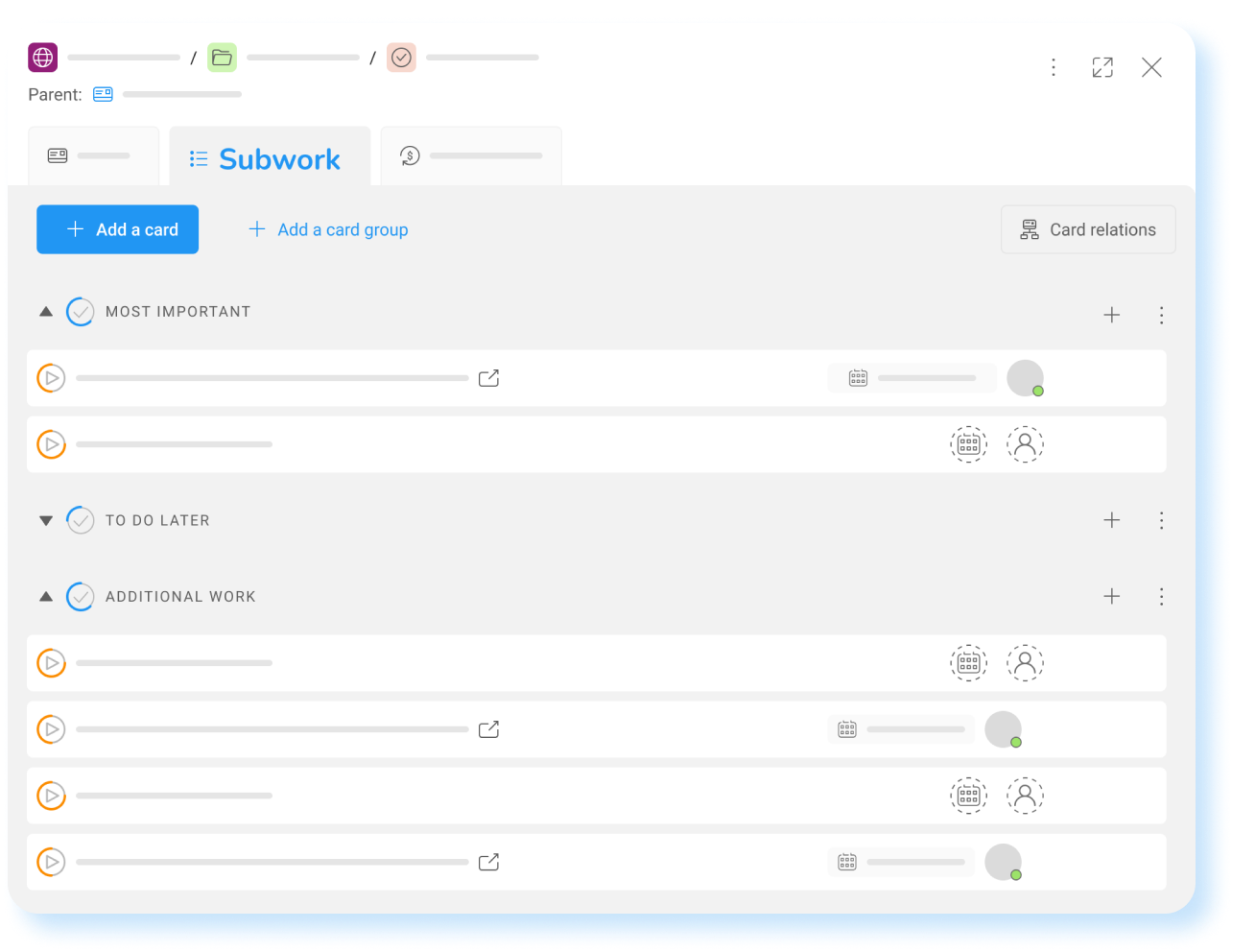
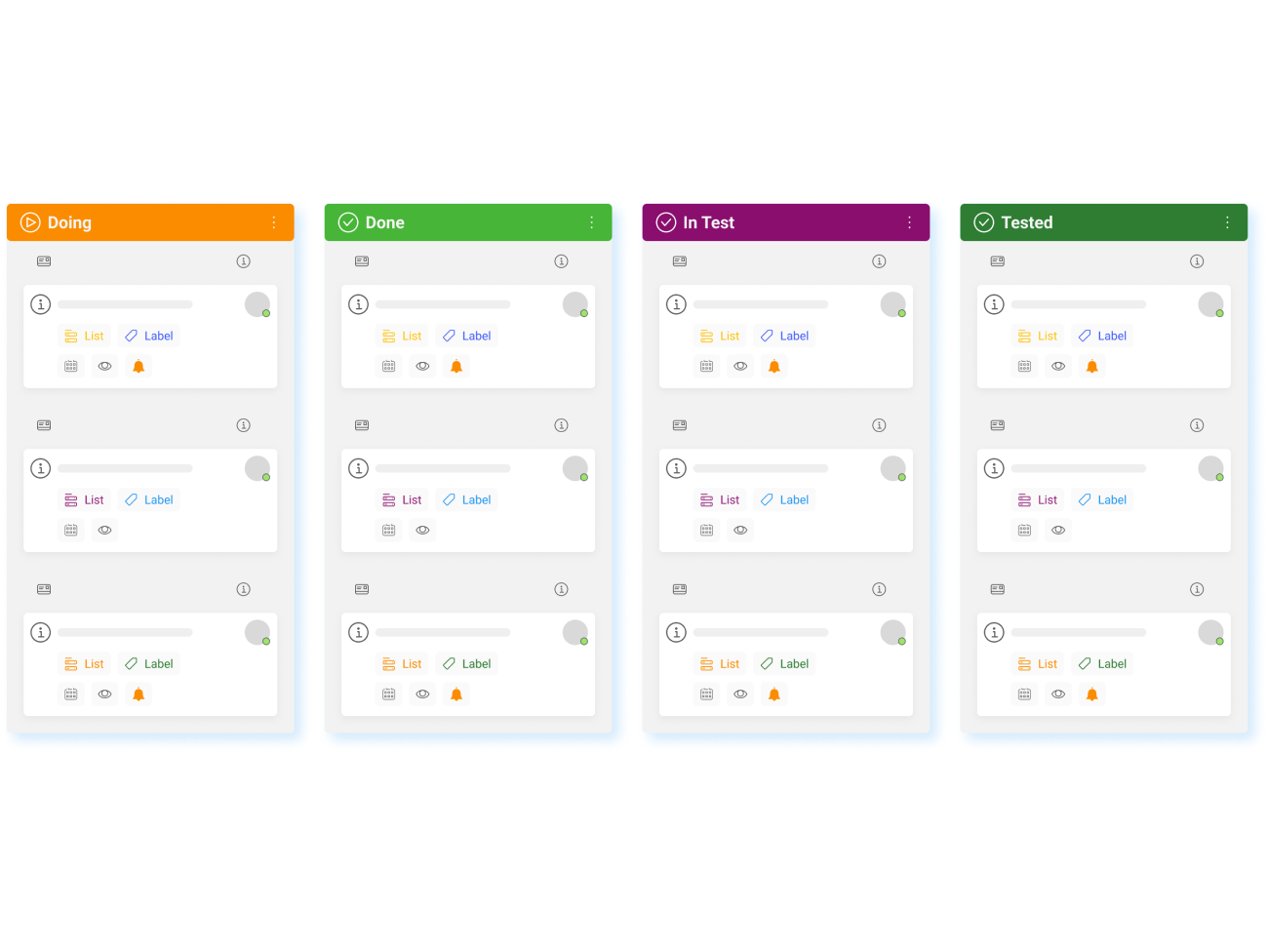
The same work, in whatever shape the moment requires
Flexibility is only real if it survives an ordinary Tuesday. These are the places a team changes how it works without leaving anything behind.

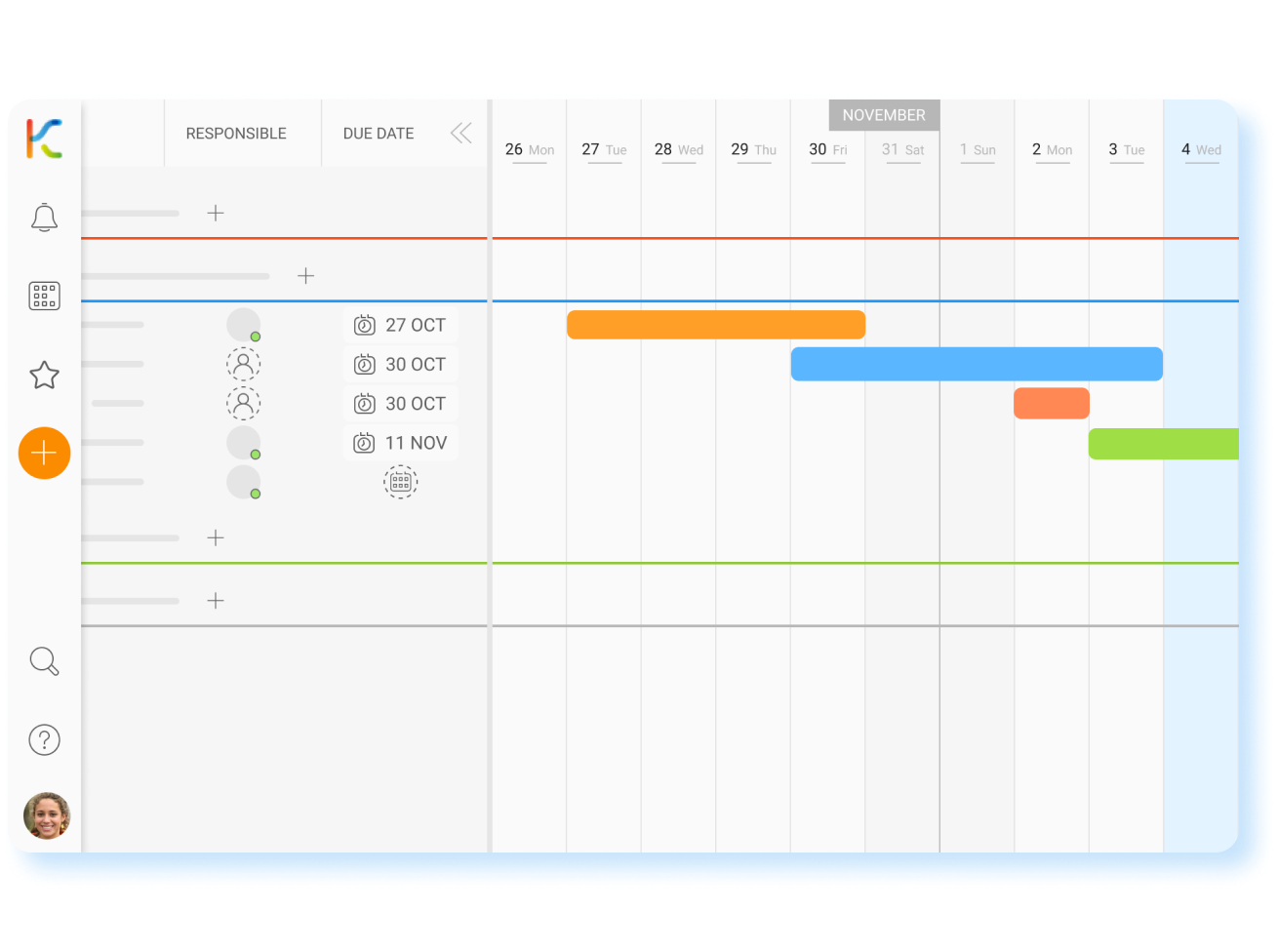
Ten views, one set of cards
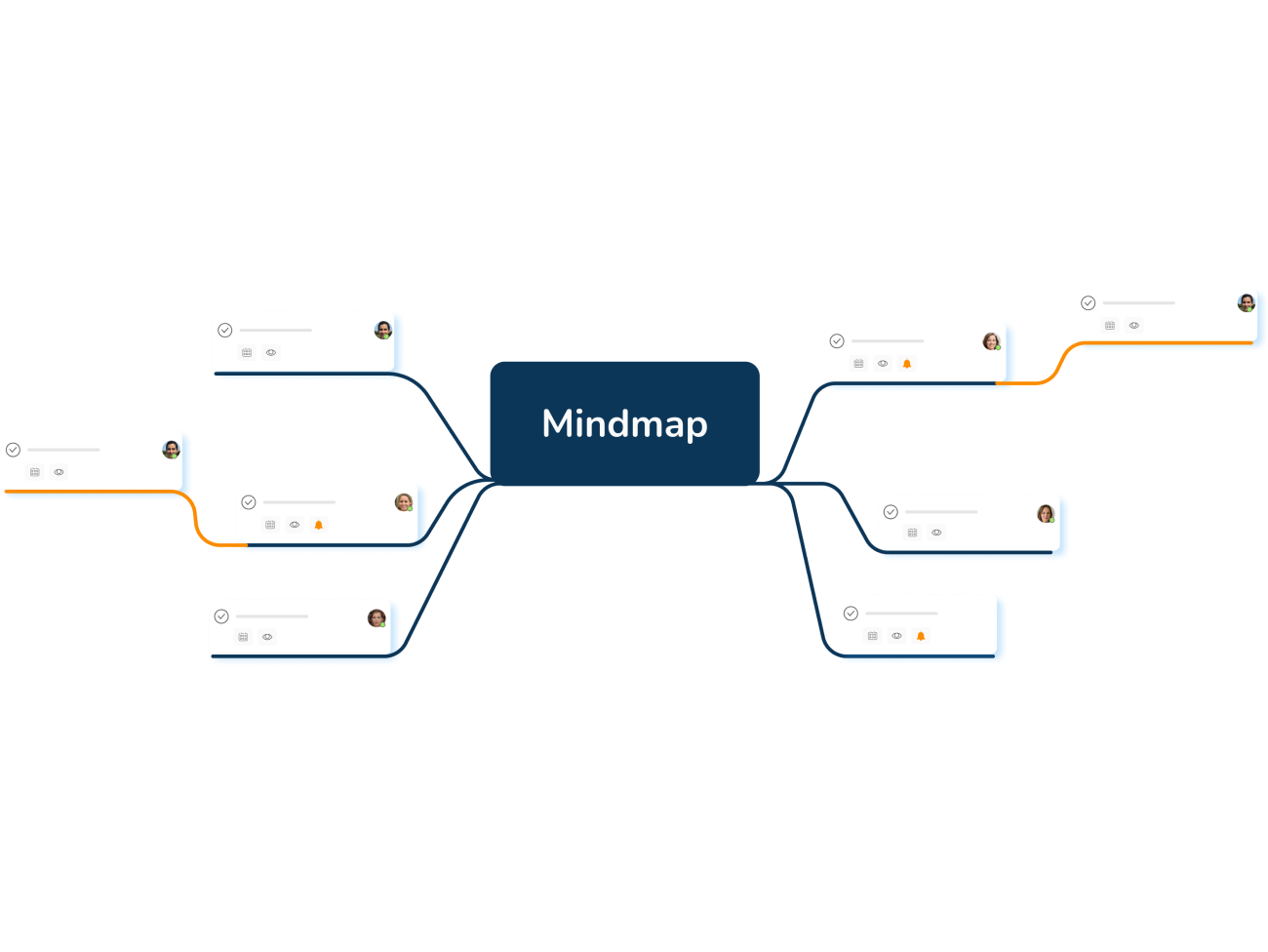
Kanban, List, Table, Calendar, Timeline, Gantt, Mind Map, Workload, Forecast Chart and Time Chart all read the same underlying work — nothing is duplicated or exported to change perspective. Mind Map is the one most often overlooked: cards are placed on a canvas and connected, which makes it a way to think a structure through before committing to it, not only to track work already defined. Changing view is not a reporting exercise. It is the same cards, asked a different question.
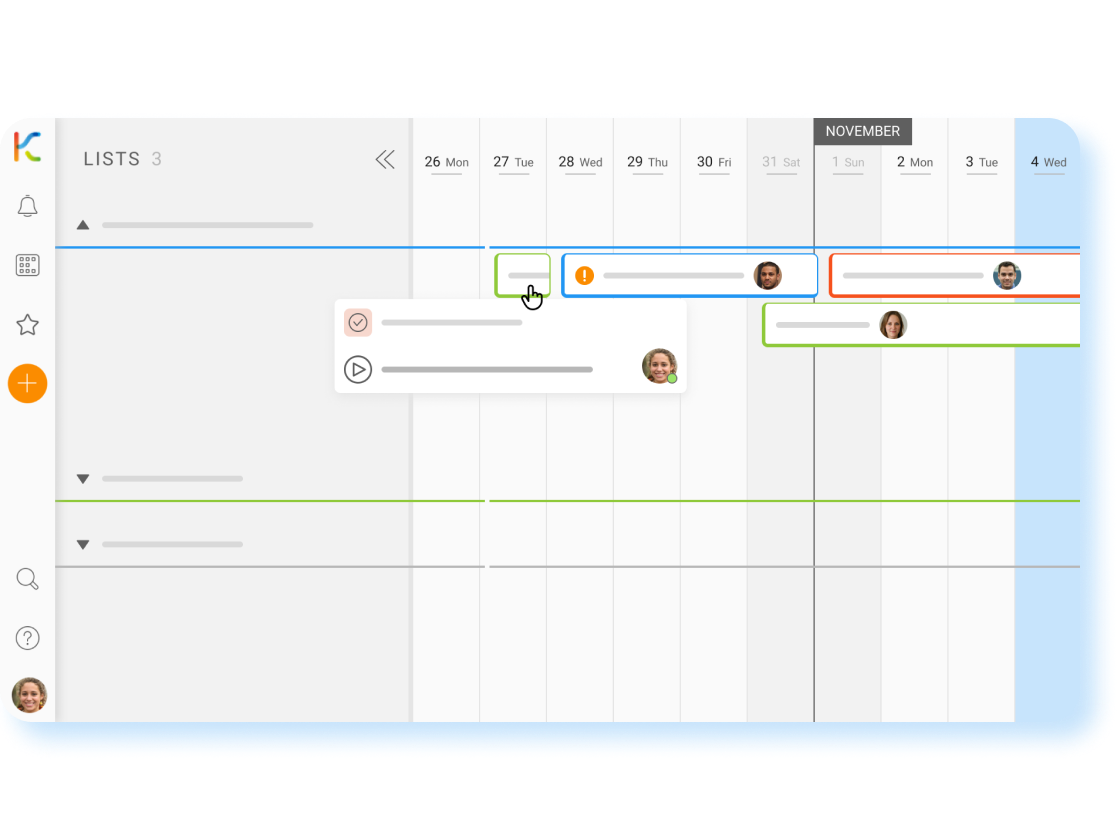

Your own view, without a second system
MySpace lets each person pull the cards they care about from any space into one private working view, with personal dates visible only to them, alarms, their own notification depth — comments only, important only, or everything — and the ability to follow tags and silence channels they do not need. The answer to "not another tool to check" is that personal focus and shared structure are the same cards. A person's working list and the organization's record never diverge.
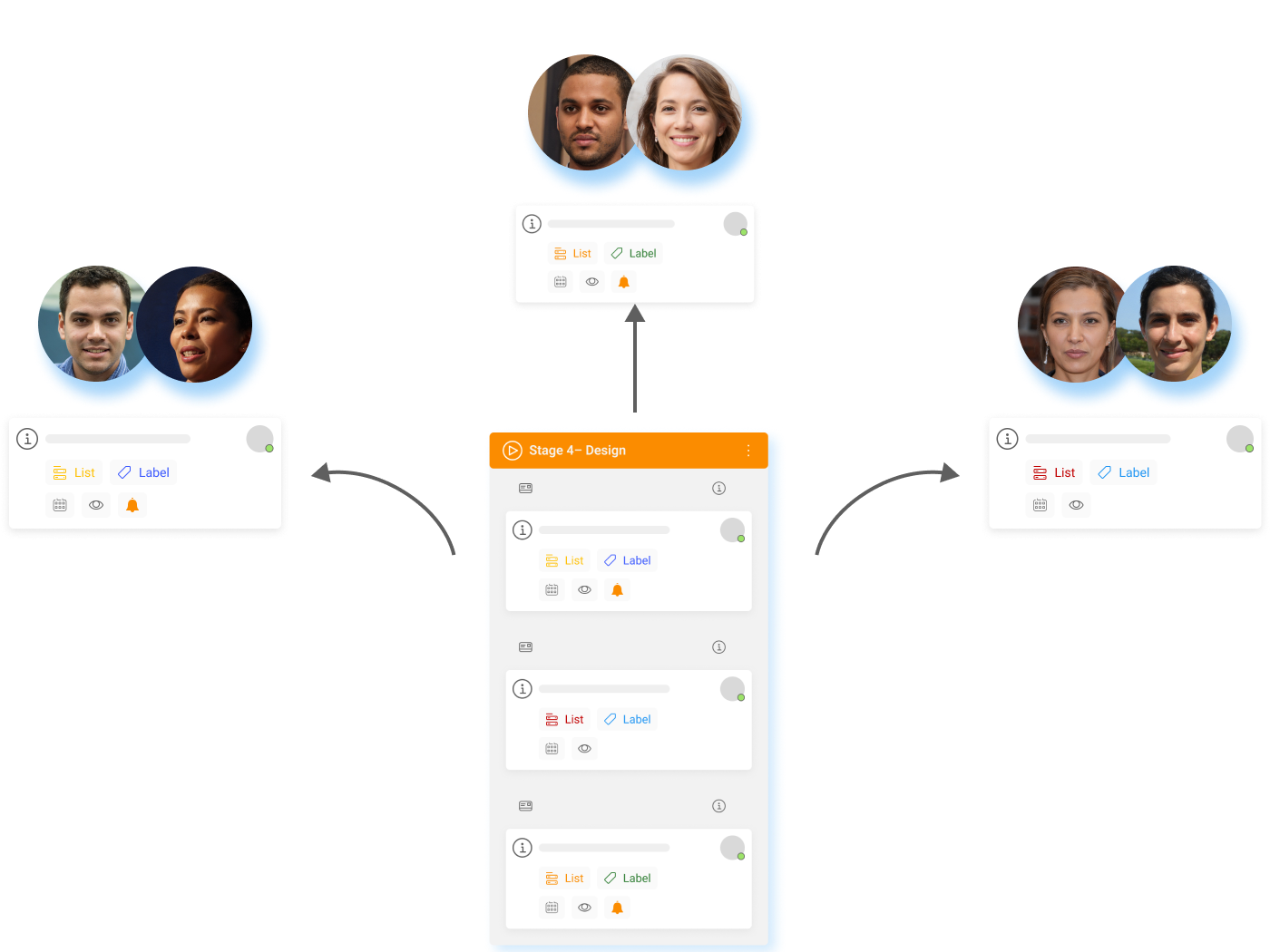

Work arrives where the work already is
Comments, mentions and activity history sit on the card, not in a parallel thread. A space or an individual card can be given its own email address, so a request forwarded from Outlook arrives as a structured card with an owner and a due date, optionally built from a card template. Who may create work by email is controlled: nobody, owners only, space owners and card members, or owners and members. Cards send email out too, with replies threading back. This is what makes distributed and hybrid working hold together. When people no longer share a room, the context that used to travel through corridor conversation has to live on the work itself. Someone joining on Thursday reads what happened on Tuesday instead of asking, and each person sets their own notification depth and calendar behaviour — KanBo dates appear in Outlook as tasks, as appointments, or not at all — so time zones and working patterns stop forcing one rhythm on everyone. Teams that live in email need not change tools on day one to start being coordinated.
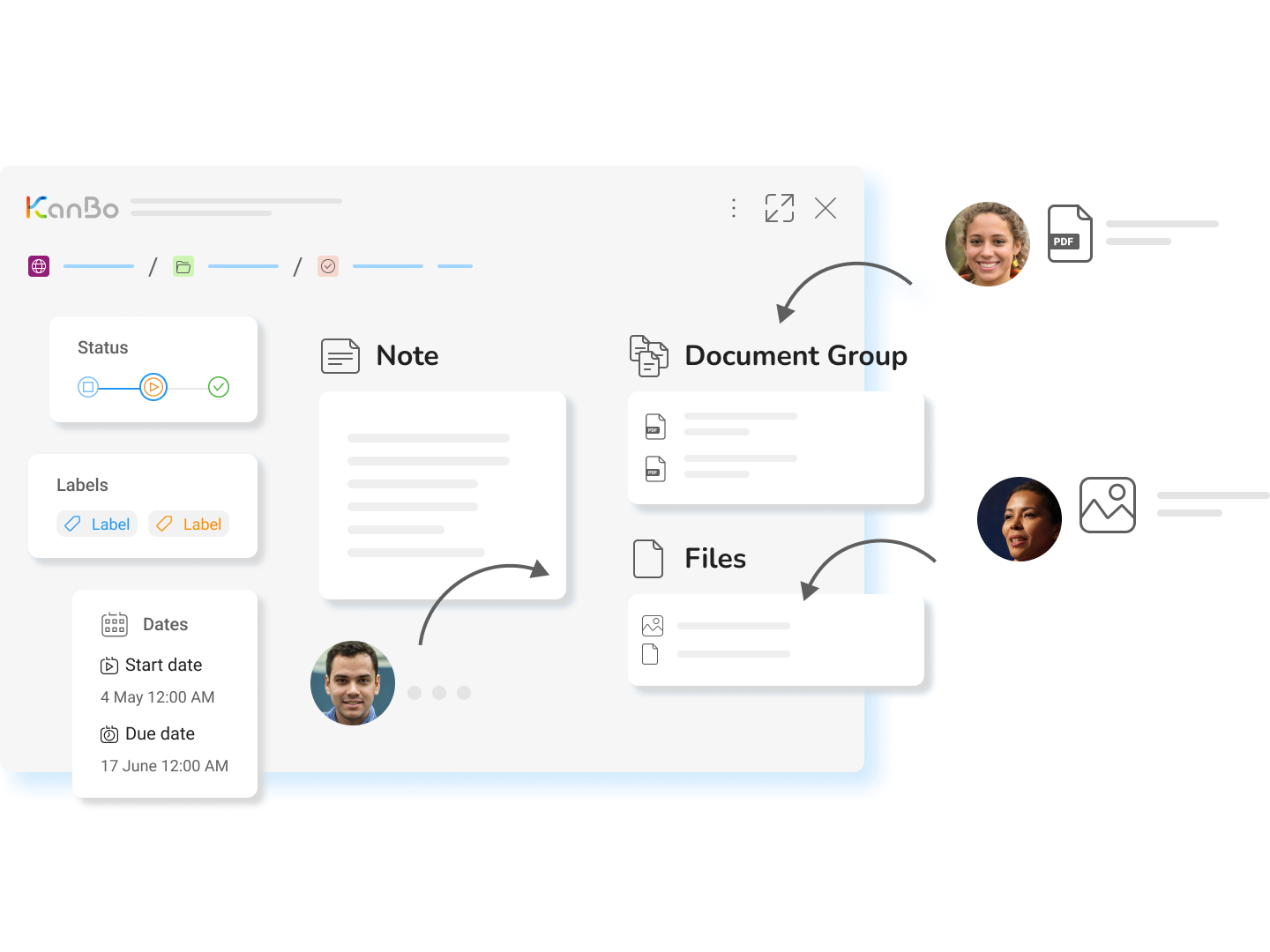

Adapt the plan to the people you actually have
Resources appear inside ordinary work views — as filters, as a Gantt column and in the Workload view — not only in a separate planning module. When priorities shift, "who is already committed" is answered in the same place the replanning happens. Bulk operations make the change practical at scale: status, dates, list, responsible person and labels can be set across many cards at once, and cards archived in bulk. Reorganizing a hundred cards after a change of direction is an operation, not a week.
Get started today with
KanBo!

KanBo is a work coordination software designed to help self-organizing teams work smarter and faster. You can see KanBo in action by accessing our Sandbox demonstration environment.
Q&A

What does "flexible work" mean in KanBo?
All of the usual senses, plus the one that makes them work. Remote and hybrid arrangements are flexible work. So is the lean organization — fewer layers, faster decisions, cross-functional teams. Underneath both sits the structural sense: statuses, views, card structure, custom fields, roles, automation rules and dependencies are configured per space by the people doing the work, and reconfigured when conditions change, while the organization keeps consistent governance and reporting across all of it.

How does KanBo support remote and hybrid teams?
By putting the context on the work rather than in the room. Each card carries its owner, contributors, documents, comments, dates and dependencies, so someone working a day or a continent away reads the situation instead of asking for a briefing. People choose their own notification depth and whether KanBo dates reach Outlook as tasks or appointments, and work can arrive by email as a structured card. Coordination stops depending on everyone being available at the same time.

How does KanBo support a leaner, cross-functional way of working?
By making a team a property of the work rather than the org chart. A cross-functional group runs in one shared space; mirror cards put the same card in front of several teams without copying it; permissions can be granted to groups, so people join and leave as the problem changes. Decisions get faster because the responsible person and the current state are on the card, and because a blocker is a named object with an owner rather than a sentence in a status meeting.
If every team configures its own space, how does anything roll up?
Through fixed anchors underneath the local vocabulary. Every status a team invents is assigned one of five types — Information, Not started, In progress, Completed, Cancelled — so progress and completion aggregate correctly whatever the team calls its stages. Card relations work across spaces, so dependencies between departments are real links rather than a maintained view. Teams differ on the surface and stay comparable underneath.
What happens to our history when we change how we work?
It stays with the work. Restructuring in KanBo is reconfiguration, not migration — cards keep their comments, documents, relations and activity history when statuses are renamed, views rebuilt or ownership moved. A checklist item that turns out to matter is promoted into a tracked card rather than retyped. Nothing resets because the process changed.
Flexible Work
KanBo is adopted at organization level. The organization decides how it is deployed, how access is governed and what stays standard across it — and inside that frame, departments and teams shape their own work around the processes they actually run rather than around the shape of a tool. Projects, workflows, documents, communication, responsibilities and dependencies take the form the work requires, and stay connected across the whole organization while they change.
Flexibility is not a convenience. Conditions change faster than organizations can redesign themselves: new regulation, new suppliers, a reorganization, a process that has to run differently next quarter. Organizations answer with remote and hybrid working, leaner structures, cross-functional teams and faster decisions — and every one of those answers depends on being able to reshape how work is coordinated without a migration project. That is what keeps an organization relevant instead of running a model it has outgrown. Self-organizing teams adapt their spaces, views, statuses and cards to their daily reality without losing shared context, governance or the connection to larger business goals. The structure changes; the record does not restart.
Flexible work without losing control
Flexible work takes two practical forms in most organizations. Remote and hybrid working: people no longer share a room, a corridor or a schedule, so coordination that used to happen by proximity has to happen somewhere explicit. And the lean organization: fewer layers, faster decisions, cross-functional teams assembled around a problem rather than an org chart. Both work only if the record keeps up with them. A third form underneath decides whether either holds — the coordination structure itself has to be changeable. In KanBo each team uses the structure, view, workflow, documents, roles and planning approach that fits its work, while the organization keeps alignment, visibility and governance across every space. The same cards serve the team's daily execution and the executive's portfolio view; only the lens changes. That is what makes adaptation cheap. When conditions change, a team reshapes how it works inside KanBo rather than negotiating a new tool, and the work's history, ownership and dependencies carry forward intact. Flexibility without that layer is merely absence of structure, which fails at scale: the organization loses sight of its own work.
Manager's question
When the work changes shape, does anyone still know who owns what?
KanBo makes responsibility explicit rather than assumed. Each card has a Responsible Person and Co-Workers; access runs across six permission levels — none, reader, visitor, member, owner, super — and can be granted to groups that contain other groups, so a reorganization changes membership rather than requiring the structure to be rebuilt. Spaces are private or shared, and closed, open to self-join, or open by request, so a team decides how open its work is without central administration.
The flexibility that matters here is not fewer roles. It is that ownership can move between people, teams and departments while the work stays in place, with its history and dependencies attached. That is what makes a lean, cross-functional team practical rather than aspirational: a group drawn from four departments works in one shared space, mirror cards put the same card in front of every team that needs it without duplicating it, and colleagues who only follow along get reader or visitor access instead of being copied into email. When the problem is solved the team dissolves and the record stays.
Oliver Hart and Bengt Holmström's Nobel-recognized work on incomplete contracts explains why this is the right design. No agreement can specify in advance everything that will need deciding; what governs behaviour is who holds the decision right when the unforeseen arrives. KanBo puts those rights on the work itself rather than in an org chart describing last year's structure.
Benefit: the right people are involved at the right level of responsibility, and ownership can change without the work being rebuilt.
Manager's question
How do we let teams adapt locally without the organization drifting apart?
KanBo connects daily execution to broader priorities through structure rather than reporting. Cards carry parent/child and predecessor/successor relations, each with a cross-space variant — so a card in one space can be the predecessor of a card in another, and a portfolio view reflects real dependencies between departments rather than a maintained summary. Labels, custom fields and configurable views group the same work by programme, department, owner or goal, depending on who is asking.
Local adaptation stops being a risk once the connections survive it: a team changes how it works without disconnecting from the initiative it belongs to.
James March's distinction between exploitation and exploration is the frame. Organizations that only exploit what already works become highly efficient at something that has stopped mattering; those that only explore compound nothing. Holding both at once requires teams free to work differently while remaining legible to the level above.
Benefit: teams adapt in execution while their work stays connected to the organization's direction.
Manager's question
Does our tool require every process to look the same, when our processes plainly do not?
Each space reflects the process it actually supports. Statuses are defined per space — name, colour and order — and each is assigned a type: Information, Not started, In progress, Completed or Cancelled. That one mechanism is what makes local vocabulary safe. A sales space can run Prospecting → Discovery → Proposal → Negotiation → Closed Won while progress and rollups keep working, because each local name is anchored to a type the platform understands.
Everything follows that principle. Cards hold typed elements — notes, checklists, document lists, document folders and sub-card groups — so a card grows with the work instead of being migrated when it outgrows a form, and a checklist item can be promoted into a full card without retyping. Custom fields come in text, number, date and select types, spaces define their own date fields beyond start and due, and automation rules are set by the space owner and can be paused rather than deleted.
W. Ross Ashby's law of requisite variety states the constraint precisely: only variety can absorb variety. A control system needs at least as many responses as the system it governs has states. A single mandated template has far less variety than the work it must cover — which is why the gap reappears as spreadsheets, side channels and shadow tools.
Benefit: processes fit the work, instead of the work being reshaped to fit the software.
Manager's question
Can leadership get clarity without standardizing teams into uniformity?
The same cards support ten views — Kanban, List, Table, Calendar, Timeline, Gantt, Mind Map, Workload, Forecast Chart and Time Chart — and each is configurable rather than fixed. Work can be grouped by list, user, status, label, due date, role, space or custom field, coloured and sorted to the question being asked, with the timeline scaled to days, weeks or months. A team lead and an executive read one set of facts from two altitudes.
Risk surfaces through those same lenses rather than in a separate report. A view can be filtered on whether a card is blocked, whether KanBo has detected a conflict between its dates and its relations, how old it is, who is responsible and how its deadlines fall — overdue, today, this week, next week, later. A leader builds the question they need instead of reading what a fixed dashboard decided to show. Blockers are managed objects with a name, a reason and a responsible owner, and can be defined once and reused across the instance, so recurring friction — waiting on legal review, a vendor SLA — becomes something the organization counts rather than mentions.
This is Stafford Beer's Viable System Model in ordinary use. A viable organization gives its operating units real autonomy and keeps cohesion by attenuating what flows upward: management sees the variety it must act on, not everything the units do. Asking every team to work identically so leadership can read one report is the opposite design, and it destroys the adaptability it was meant to control.
Benefit: managers gain control through transparency rather than through standardization or status requests.
The same work, in whatever shape the moment requires
Flexibility is only real if it survives an ordinary Tuesday. These are the places a team changes how it works without leaving anything behind.
Ten views, one set of cards
Kanban, List, Table, Calendar, Timeline, Gantt, Mind Map, Workload, Forecast Chart and Time Chart all read the same underlying work — nothing is duplicated or exported to change perspective. Mind Map is the one most often overlooked: cards are placed on a canvas and connected, which makes it a way to think a structure through before committing to it, not only to track work already defined. Changing view is not a reporting exercise. It is the same cards, asked a different question.
Your own view, without a second system
MySpace lets each person pull the cards they care about from any space into one private working view, with personal dates visible only to them, alarms, their own notification depth — comments only, important only, or everything — and the ability to follow tags and silence channels they do not need. The answer to "not another tool to check" is that personal focus and shared structure are the same cards. A person's working list and the organization's record never diverge.
Work arrives where the work already is
Comments, mentions and activity history sit on the card, not in a parallel thread. A space or an individual card can be given its own email address, so a request forwarded from Outlook arrives as a structured card with an owner and a due date, optionally built from a card template. Who may create work by email is controlled: nobody, owners only, space owners and card members, or owners and members. Cards send email out too, with replies threading back. This is what makes distributed and hybrid working hold together. When people no longer share a room, the context that used to travel through corridor conversation has to live on the work itself. Someone joining on Thursday reads what happened on Tuesday instead of asking, and each person sets their own notification depth and calendar behaviour — KanBo dates appear in Outlook as tasks, as appointments, or not at all — so time zones and working patterns stop forcing one rhythm on everyone. Teams that live in email need not change tools on day one to start being coordinated.
Adapt the plan to the people you actually have
Resources appear inside ordinary work views — as filters, as a Gantt column and in the Workload view — not only in a separate planning module. When priorities shift, "who is already committed" is answered in the same place the replanning happens. Bulk operations make the change practical at scale: status, dates, list, responsible person and labels can be set across many cards at once, and cards archived in bulk. Reorganizing a hundred cards after a change of direction is an operation, not a week.
Get started today with KanBo!
KanBo is a work coordination software designed to help self-organizing teams work smarter and faster. You can see KanBo in action by accessing our Sandbox demonstration environment.
Q&A
What does "flexible work" mean in KanBo?
All of the usual senses, plus the one that makes them work. Remote and hybrid arrangements are flexible work. So is the lean organization — fewer layers, faster decisions, cross-functional teams. Underneath both sits the structural sense: statuses, views, card structure, custom fields, roles, automation rules and dependencies are configured per space by the people doing the work, and reconfigured when conditions change, while the organization keeps consistent governance and reporting across all of it.
How does KanBo support remote and hybrid teams?
By putting the context on the work rather than in the room. Each card carries its owner, contributors, documents, comments, dates and dependencies, so someone working a day or a continent away reads the situation instead of asking for a briefing. People choose their own notification depth and whether KanBo dates reach Outlook as tasks or appointments, and work can arrive by email as a structured card. Coordination stops depending on everyone being available at the same time.
How does KanBo support a leaner, cross-functional way of working?
By making a team a property of the work rather than the org chart. A cross-functional group runs in one shared space; mirror cards put the same card in front of several teams without copying it; permissions can be granted to groups, so people join and leave as the problem changes. Decisions get faster because the responsible person and the current state are on the card, and because a blocker is a named object with an owner rather than a sentence in a status meeting.
If every team configures its own space, how does anything roll up?
Through fixed anchors underneath the local vocabulary. Every status a team invents is assigned one of five types — Information, Not started, In progress, Completed, Cancelled — so progress and completion aggregate correctly whatever the team calls its stages. Card relations work across spaces, so dependencies between departments are real links rather than a maintained view. Teams differ on the surface and stay comparable underneath.
What happens to our history when we change how we work?
It stays with the work. Restructuring in KanBo is reconfiguration, not migration — cards keep their comments, documents, relations and activity history when statuses are renamed, views rebuilt or ownership moved. A checklist item that turns out to matter is promoted into a tracked card rather than retyped. Nothing resets because the process changed.
Flexible Work
KanBo is adopted at organization level. The organization decides how it is deployed, how access is governed and what stays standard across it — and inside that frame, departments and teams shape their own work around the processes they actually run rather than around the shape of a tool. Projects, workflows, documents, communication, responsibilities and dependencies take the form the work requires, and stay connected across the whole organization while they change.
Flexibility is not a convenience. Conditions change faster than organizations can redesign themselves: new regulation, new suppliers, a reorganization, a process that has to run differently next quarter. Organizations answer with remote and hybrid working, leaner structures, cross-functional teams and faster decisions — and every one of those answers depends on being able to reshape how work is coordinated without a migration project. That is what keeps an organization relevant instead of running a model it has outgrown. Self-organizing teams adapt their spaces, views, statuses and cards to their daily reality without losing shared context, governance or the connection to larger business goals. The structure changes; the record does not restart.
Flexible work without losing control
Flexible work takes two practical forms in most organizations. Remote and hybrid working: people no longer share a room, a corridor or a schedule, so coordination that used to happen by proximity has to happen somewhere explicit. And the lean organization: fewer layers, faster decisions, cross-functional teams assembled around a problem rather than an org chart. Both work only if the record keeps up with them. A third form underneath decides whether either holds — the coordination structure itself has to be changeable. In KanBo each team uses the structure, view, workflow, documents, roles and planning approach that fits its work, while the organization keeps alignment, visibility and governance across every space. The same cards serve the team's daily execution and the executive's portfolio view; only the lens changes. That is what makes adaptation cheap. When conditions change, a team reshapes how it works inside KanBo rather than negotiating a new tool, and the work's history, ownership and dependencies carry forward intact. Flexibility without that layer is merely absence of structure, which fails at scale: the organization loses sight of its own work.
Manager's question
When the work changes shape, does anyone still know who owns what?
KanBo makes responsibility explicit rather than assumed. Each card has a Responsible Person and Co-Workers; access runs across six permission levels — none, reader, visitor, member, owner, super — and can be granted to groups that contain other groups, so a reorganization changes membership rather than requiring the structure to be rebuilt. Spaces are private or shared, and closed, open to self-join, or open by request, so a team decides how open its work is without central administration.
The flexibility that matters here is not fewer roles. It is that ownership can move between people, teams and departments while the work stays in place, with its history and dependencies attached. That is what makes a lean, cross-functional team practical rather than aspirational: a group drawn from four departments works in one shared space, mirror cards put the same card in front of every team that needs it without duplicating it, and colleagues who only follow along get reader or visitor access instead of being copied into email. When the problem is solved the team dissolves and the record stays.
Oliver Hart and Bengt Holmström's Nobel-recognized work on incomplete contracts explains why this is the right design. No agreement can specify in advance everything that will need deciding; what governs behaviour is who holds the decision right when the unforeseen arrives. KanBo puts those rights on the work itself rather than in an org chart describing last year's structure.
Benefit: the right people are involved at the right level of responsibility, and ownership can change without the work being rebuilt.
Manager's question
How do we let teams adapt locally without the organization drifting apart?
KanBo connects daily execution to broader priorities through structure rather than reporting. Cards carry parent/child and predecessor/successor relations, each with a cross-space variant — so a card in one space can be the predecessor of a card in another, and a portfolio view reflects real dependencies between departments rather than a maintained summary. Labels, custom fields and configurable views group the same work by programme, department, owner or goal, depending on who is asking.
Local adaptation stops being a risk once the connections survive it: a team changes how it works without disconnecting from the initiative it belongs to.
James March's distinction between exploitation and exploration is the frame. Organizations that only exploit what already works become highly efficient at something that has stopped mattering; those that only explore compound nothing. Holding both at once requires teams free to work differently while remaining legible to the level above.
Benefit: teams adapt in execution while their work stays connected to the organization's direction.
Manager's question
Does our tool require every process to look the same, when our processes plainly do not?
Each space reflects the process it actually supports. Statuses are defined per space — name, colour and order — and each is assigned a type: Information, Not started, In progress, Completed or Cancelled. That one mechanism is what makes local vocabulary safe. A sales space can run Prospecting → Discovery → Proposal → Negotiation → Closed Won while progress and rollups keep working, because each local name is anchored to a type the platform understands.
Everything follows that principle. Cards hold typed elements — notes, checklists, document lists, document folders and sub-card groups — so a card grows with the work instead of being migrated when it outgrows a form, and a checklist item can be promoted into a full card without retyping. Custom fields come in text, number, date and select types, spaces define their own date fields beyond start and due, and automation rules are set by the space owner and can be paused rather than deleted.
W. Ross Ashby's law of requisite variety states the constraint precisely: only variety can absorb variety. A control system needs at least as many responses as the system it governs has states. A single mandated template has far less variety than the work it must cover — which is why the gap reappears as spreadsheets, side channels and shadow tools.
Benefit: processes fit the work, instead of the work being reshaped to fit the software.
Manager's question
Can leadership get clarity without standardizing teams into uniformity?
The same cards support ten views — Kanban, List, Table, Calendar, Timeline, Gantt, Mind Map, Workload, Forecast Chart and Time Chart — and each is configurable rather than fixed. Work can be grouped by list, user, status, label, due date, role, space or custom field, coloured and sorted to the question being asked, with the timeline scaled to days, weeks or months. A team lead and an executive read one set of facts from two altitudes.
Risk surfaces through those same lenses rather than in a separate report. A view can be filtered on whether a card is blocked, whether KanBo has detected a conflict between its dates and its relations, how old it is, who is responsible and how its deadlines fall — overdue, today, this week, next week, later. A leader builds the question they need instead of reading what a fixed dashboard decided to show. Blockers are managed objects with a name, a reason and a responsible owner, and can be defined once and reused across the instance, so recurring friction — waiting on legal review, a vendor SLA — becomes something the organization counts rather than mentions.
This is Stafford Beer's Viable System Model in ordinary use. A viable organization gives its operating units real autonomy and keeps cohesion by attenuating what flows upward: management sees the variety it must act on, not everything the units do. Asking every team to work identically so leadership can read one report is the opposite design, and it destroys the adaptability it was meant to control.
Benefit: managers gain control through transparency rather than through standardization or status requests.
The same work, in whatever shape the moment requires
Flexibility is only real if it survives an ordinary Tuesday. These are the places a team changes how it works without leaving anything behind.
Ten views, one set of cards
Kanban, List, Table, Calendar, Timeline, Gantt, Mind Map, Workload, Forecast Chart and Time Chart all read the same underlying work — nothing is duplicated or exported to change perspective. Mind Map is the one most often overlooked: cards are placed on a canvas and connected, which makes it a way to think a structure through before committing to it, not only to track work already defined. Changing view is not a reporting exercise. It is the same cards, asked a different question.
Your own view, without a second system
MySpace lets each person pull the cards they care about from any space into one private working view, with personal dates visible only to them, alarms, their own notification depth — comments only, important only, or everything — and the ability to follow tags and silence channels they do not need. The answer to "not another tool to check" is that personal focus and shared structure are the same cards. A person's working list and the organization's record never diverge.
Work arrives where the work already is
Comments, mentions and activity history sit on the card, not in a parallel thread. A space or an individual card can be given its own email address, so a request forwarded from Outlook arrives as a structured card with an owner and a due date, optionally built from a card template. Who may create work by email is controlled: nobody, owners only, space owners and card members, or owners and members. Cards send email out too, with replies threading back. This is what makes distributed and hybrid working hold together. When people no longer share a room, the context that used to travel through corridor conversation has to live on the work itself. Someone joining on Thursday reads what happened on Tuesday instead of asking, and each person sets their own notification depth and calendar behaviour — KanBo dates appear in Outlook as tasks, as appointments, or not at all — so time zones and working patterns stop forcing one rhythm on everyone. Teams that live in email need not change tools on day one to start being coordinated.
Adapt the plan to the people you actually have
Resources appear inside ordinary work views — as filters, as a Gantt column and in the Workload view — not only in a separate planning module. When priorities shift, "who is already committed" is answered in the same place the replanning happens. Bulk operations make the change practical at scale: status, dates, list, responsible person and labels can be set across many cards at once, and cards archived in bulk. Reorganizing a hundred cards after a change of direction is an operation, not a week.
Get started today with KanBo!
KanBo is a work coordination software designed to help self-organizing teams work smarter and faster. You can see KanBo in action by accessing our Sandbox demonstration environment.
Q&A
What does "flexible work" mean in KanBo?
All of the usual senses, plus the one that makes them work. Remote and hybrid arrangements are flexible work. So is the lean organization — fewer layers, faster decisions, cross-functional teams. Underneath both sits the structural sense: statuses, views, card structure, custom fields, roles, automation rules and dependencies are configured per space by the people doing the work, and reconfigured when conditions change, while the organization keeps consistent governance and reporting across all of it.
How does KanBo support remote and hybrid teams?
By putting the context on the work rather than in the room. Each card carries its owner, contributors, documents, comments, dates and dependencies, so someone working a day or a continent away reads the situation instead of asking for a briefing. People choose their own notification depth and whether KanBo dates reach Outlook as tasks or appointments, and work can arrive by email as a structured card. Coordination stops depending on everyone being available at the same time.
How does KanBo support a leaner, cross-functional way of working?
By making a team a property of the work rather than the org chart. A cross-functional group runs in one shared space; mirror cards put the same card in front of several teams without copying it; permissions can be granted to groups, so people join and leave as the problem changes. Decisions get faster because the responsible person and the current state are on the card, and because a blocker is a named object with an owner rather than a sentence in a status meeting.
If every team configures its own space, how does anything roll up?
Through fixed anchors underneath the local vocabulary. Every status a team invents is assigned one of five types — Information, Not started, In progress, Completed, Cancelled — so progress and completion aggregate correctly whatever the team calls its stages. Card relations work across spaces, so dependencies between departments are real links rather than a maintained view. Teams differ on the surface and stay comparable underneath.
What happens to our history when we change how we work?
It stays with the work. Restructuring in KanBo is reconfiguration, not migration — cards keep their comments, documents, relations and activity history when statuses are renamed, views rebuilt or ownership moved. A checklist item that turns out to matter is promoted into a tracked card rather than retyped. Nothing resets because the process changed.
Flexible Work
KanBo is adopted at organization level. The organization decides how it is deployed, how access is governed and what stays standard across it — and inside that frame, departments and teams shape their own work around the processes they actually run rather than around the shape of a tool. Projects, workflows, documents, communication, responsibilities and dependencies take the form the work requires, and stay connected across the whole organization while they change.
Flexibility is not a convenience. Conditions change faster than organizations can redesign themselves: new regulation, new suppliers, a reorganization, a process that has to run differently next quarter. Organizations answer with remote and hybrid working, leaner structures, cross-functional teams and faster decisions — and every one of those answers depends on being able to reshape how work is coordinated without a migration project. That is what keeps an organization relevant instead of running a model it has outgrown. Self-organizing teams adapt their spaces, views, statuses and cards to their daily reality without losing shared context, governance or the connection to larger business goals. The structure changes; the record does not restart.
Flexible work without losing control
Flexible work takes two practical forms in most organizations. Remote and hybrid working: people no longer share a room, a corridor or a schedule, so coordination that used to happen by proximity has to happen somewhere explicit. And the lean organization: fewer layers, faster decisions, cross-functional teams assembled around a problem rather than an org chart. Both work only if the record keeps up with them. A third form underneath decides whether either holds — the coordination structure itself has to be changeable. In KanBo each team uses the structure, view, workflow, documents, roles and planning approach that fits its work, while the organization keeps alignment, visibility and governance across every space. The same cards serve the team's daily execution and the executive's portfolio view; only the lens changes. That is what makes adaptation cheap. When conditions change, a team reshapes how it works inside KanBo rather than negotiating a new tool, and the work's history, ownership and dependencies carry forward intact. Flexibility without that layer is merely absence of structure, which fails at scale: the organization loses sight of its own work.
Manager's question
When the work changes shape, does anyone still know who owns what?
KanBo makes responsibility explicit rather than assumed. Each card has a Responsible Person and Co-Workers; access runs across six permission levels — none, reader, visitor, member, owner, super — and can be granted to groups that contain other groups, so a reorganization changes membership rather than requiring the structure to be rebuilt. Spaces are private or shared, and closed, open to self-join, or open by request, so a team decides how open its work is without central administration.
The flexibility that matters here is not fewer roles. It is that ownership can move between people, teams and departments while the work stays in place, with its history and dependencies attached. That is what makes a lean, cross-functional team practical rather than aspirational: a group drawn from four departments works in one shared space, mirror cards put the same card in front of every team that needs it without duplicating it, and colleagues who only follow along get reader or visitor access instead of being copied into email. When the problem is solved the team dissolves and the record stays.
Oliver Hart and Bengt Holmström's Nobel-recognized work on incomplete contracts explains why this is the right design. No agreement can specify in advance everything that will need deciding; what governs behaviour is who holds the decision right when the unforeseen arrives. KanBo puts those rights on the work itself rather than in an org chart describing last year's structure.
Benefit: the right people are involved at the right level of responsibility, and ownership can change without the work being rebuilt.
Manager's question
How do we let teams adapt locally without the organization drifting apart?
KanBo connects daily execution to broader priorities through structure rather than reporting. Cards carry parent/child and predecessor/successor relations, each with a cross-space variant — so a card in one space can be the predecessor of a card in another, and a portfolio view reflects real dependencies between departments rather than a maintained summary. Labels, custom fields and configurable views group the same work by programme, department, owner or goal, depending on who is asking.
Local adaptation stops being a risk once the connections survive it: a team changes how it works without disconnecting from the initiative it belongs to.
James March's distinction between exploitation and exploration is the frame. Organizations that only exploit what already works become highly efficient at something that has stopped mattering; those that only explore compound nothing. Holding both at once requires teams free to work differently while remaining legible to the level above.
Benefit: teams adapt in execution while their work stays connected to the organization's direction.
Manager's question
Does our tool require every process to look the same, when our processes plainly do not?
Each space reflects the process it actually supports. Statuses are defined per space — name, colour and order — and each is assigned a type: Information, Not started, In progress, Completed or Cancelled. That one mechanism is what makes local vocabulary safe. A sales space can run Prospecting → Discovery → Proposal → Negotiation → Closed Won while progress and rollups keep working, because each local name is anchored to a type the platform understands.
Everything follows that principle. Cards hold typed elements — notes, checklists, document lists, document folders and sub-card groups — so a card grows with the work instead of being migrated when it outgrows a form, and a checklist item can be promoted into a full card without retyping. Custom fields come in text, number, date and select types, spaces define their own date fields beyond start and due, and automation rules are set by the space owner and can be paused rather than deleted.
W. Ross Ashby's law of requisite variety states the constraint precisely: only variety can absorb variety. A control system needs at least as many responses as the system it governs has states. A single mandated template has far less variety than the work it must cover — which is why the gap reappears as spreadsheets, side channels and shadow tools.
Benefit: processes fit the work, instead of the work being reshaped to fit the software.
Manager's question
Can leadership get clarity without standardizing teams into uniformity?
The same cards support ten views — Kanban, List, Table, Calendar, Timeline, Gantt, Mind Map, Workload, Forecast Chart and Time Chart — and each is configurable rather than fixed. Work can be grouped by list, user, status, label, due date, role, space or custom field, coloured and sorted to the question being asked, with the timeline scaled to days, weeks or months. A team lead and an executive read one set of facts from two altitudes.
Risk surfaces through those same lenses rather than in a separate report. A view can be filtered on whether a card is blocked, whether KanBo has detected a conflict between its dates and its relations, how old it is, who is responsible and how its deadlines fall — overdue, today, this week, next week, later. A leader builds the question they need instead of reading what a fixed dashboard decided to show. Blockers are managed objects with a name, a reason and a responsible owner, and can be defined once and reused across the instance, so recurring friction — waiting on legal review, a vendor SLA — becomes something the organization counts rather than mentions.
This is Stafford Beer's Viable System Model in ordinary use. A viable organization gives its operating units real autonomy and keeps cohesion by attenuating what flows upward: management sees the variety it must act on, not everything the units do. Asking every team to work identically so leadership can read one report is the opposite design, and it destroys the adaptability it was meant to control.
Benefit: managers gain control through transparency rather than through standardization or status requests.
The same work, in whatever shape the moment requires
Flexibility is only real if it survives an ordinary Tuesday. These are the places a team changes how it works without leaving anything behind.
Ten views, one set of cards
Kanban, List, Table, Calendar, Timeline, Gantt, Mind Map, Workload, Forecast Chart and Time Chart all read the same underlying work — nothing is duplicated or exported to change perspective. Mind Map is the one most often overlooked: cards are placed on a canvas and connected, which makes it a way to think a structure through before committing to it, not only to track work already defined. Changing view is not a reporting exercise. It is the same cards, asked a different question.
Your own view, without a second system
MySpace lets each person pull the cards they care about from any space into one private working view, with personal dates visible only to them, alarms, their own notification depth — comments only, important only, or everything — and the ability to follow tags and silence channels they do not need. The answer to "not another tool to check" is that personal focus and shared structure are the same cards. A person's working list and the organization's record never diverge.
Work arrives where the work already is
Comments, mentions and activity history sit on the card, not in a parallel thread. A space or an individual card can be given its own email address, so a request forwarded from Outlook arrives as a structured card with an owner and a due date, optionally built from a card template. Who may create work by email is controlled: nobody, owners only, space owners and card members, or owners and members. Cards send email out too, with replies threading back. This is what makes distributed and hybrid working hold together. When people no longer share a room, the context that used to travel through corridor conversation has to live on the work itself. Someone joining on Thursday reads what happened on Tuesday instead of asking, and each person sets their own notification depth and calendar behaviour — KanBo dates appear in Outlook as tasks, as appointments, or not at all — so time zones and working patterns stop forcing one rhythm on everyone. Teams that live in email need not change tools on day one to start being coordinated.
Adapt the plan to the people you actually have
Resources appear inside ordinary work views — as filters, as a Gantt column and in the Workload view — not only in a separate planning module. When priorities shift, "who is already committed" is answered in the same place the replanning happens. Bulk operations make the change practical at scale: status, dates, list, responsible person and labels can be set across many cards at once, and cards archived in bulk. Reorganizing a hundred cards after a change of direction is an operation, not a week.
Get started today with KanBo!
KanBo is a work coordination software designed to help self-organizing teams work smarter and faster. You can see KanBo in action by accessing our Sandbox demonstration environment.
Q&A
What does "flexible work" mean in KanBo?
All of the usual senses, plus the one that makes them work. Remote and hybrid arrangements are flexible work. So is the lean organization — fewer layers, faster decisions, cross-functional teams. Underneath both sits the structural sense: statuses, views, card structure, custom fields, roles, automation rules and dependencies are configured per space by the people doing the work, and reconfigured when conditions change, while the organization keeps consistent governance and reporting across all of it.
How does KanBo support remote and hybrid teams?
By putting the context on the work rather than in the room. Each card carries its owner, contributors, documents, comments, dates and dependencies, so someone working a day or a continent away reads the situation instead of asking for a briefing. People choose their own notification depth and whether KanBo dates reach Outlook as tasks or appointments, and work can arrive by email as a structured card. Coordination stops depending on everyone being available at the same time.
How does KanBo support a leaner, cross-functional way of working?
By making a team a property of the work rather than the org chart. A cross-functional group runs in one shared space; mirror cards put the same card in front of several teams without copying it; permissions can be granted to groups, so people join and leave as the problem changes. Decisions get faster because the responsible person and the current state are on the card, and because a blocker is a named object with an owner rather than a sentence in a status meeting.
If every team configures its own space, how does anything roll up?
Through fixed anchors underneath the local vocabulary. Every status a team invents is assigned one of five types — Information, Not started, In progress, Completed, Cancelled — so progress and completion aggregate correctly whatever the team calls its stages. Card relations work across spaces, so dependencies between departments are real links rather than a maintained view. Teams differ on the surface and stay comparable underneath.
What happens to our history when we change how we work?
It stays with the work. Restructuring in KanBo is reconfiguration, not migration — cards keep their comments, documents, relations and activity history when statuses are renamed, views rebuilt or ownership moved. A checklist item that turns out to matter is promoted into a tracked card rather than retyped. Nothing resets because the process changed.