

KanBo Perspective
The Unmeasured Function
KanBo Perspective
The Unmeasured Function
Coordination is the largest cost centre in most organizations, and the only one with no measurement discipline. The reason is not technical.
Every serious function in an enterprise has a measurement discipline, and not one of them existed by default. Each was constructed, argued over for years, and eventually standardized. Each converted a set of activities that felt like judgment into something a board could inspect.
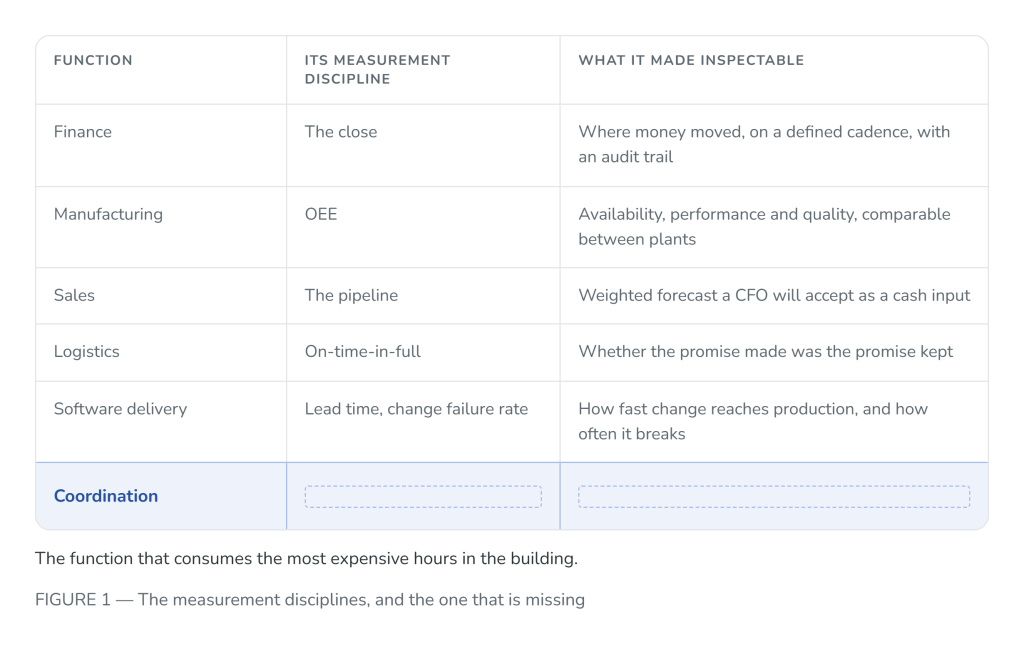
Now name the equivalent for coordination.
Coordination is the work of aligning people who depend on each other: the handoffs, the escalations, the sequencing, the meetings where a decision pending for three weeks is finally made or, more often, deferred again. It consumes the most expensive hours in the building. Its instruments are a calendar, a set of minutes, and a collective feeling that this quarter went better than the last.
Ask an executive what proportion of their organization’s work is currently waiting on someone else. You will not get a number. You will get an anecdote, delivered confidently, drawn from the two examples they happen to see.
Why coordination resisted measurement
Two obstacles are ordinary. The third explains everything.
It has no natural unit, and no native record. Manufacturing counts units against capacity; finance counts transactions posted to accounts. What is one coordination — a meeting, a handoff, a decision? And unlike a payment, coordination has historically been recorded nowhere, or in artifacts built for another purpose. Both problems are solvable. Software delivery solved the first by picking a slightly arbitrary unit and applying it consistently, which is all a unit has to do.
The third obstacle is that coordination data is not metadata about the work. It is the work.
Who is blocked on whom. Which decision has been deferred four times. Which team consistently receives its inputs late. Whose approval is the recurring constraint. Which projects the organization has quietly stopped resourcing without admitting it.
That is a map of an organization’s internal politics, capability gaps, and individual performance problems, in a form precise enough to act on. Manufacturing OEE tells you a machine’s utilization. This tells you who is failing whom.
And here is where the discipline died, repeatedly, for two decades. The tools capable of capturing it were built as multi-tenant services, and the honest description of what they asked for was: route your organization’s internal power map through infrastructure you do not control, operated by a vendor whose commercial interest is in aggregating it.
For a bank, a defence supplier, a hospital system, or any government body, that trade is not difficult. It is refused. So the organizations with the most coordination complexity — where the measurement would be worth the most — opted out entirely.
The function with the highest measurement value is the least measured. Not because the technology was hard, but because the delivery model asked for something no serious institution should agree to.
What the absence costs
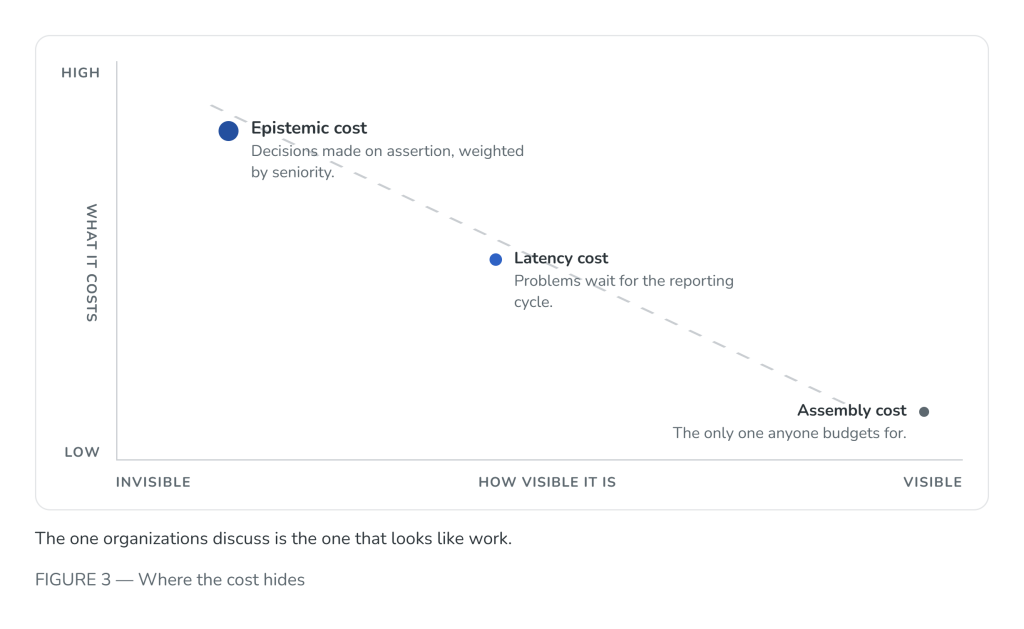
The assembly cost. Someone builds the picture before the meeting: several systems, four messages, two people who don’t reply, a spreadsheet reconciled against a plan last updated in April. Organizations underestimate this because it is distributed — forty minutes here, twenty there, weekly, across every recurring review. It never appears as a line item. It is also the smallest of the three, and the only one anyone discusses, because it is the only one that looks like work.
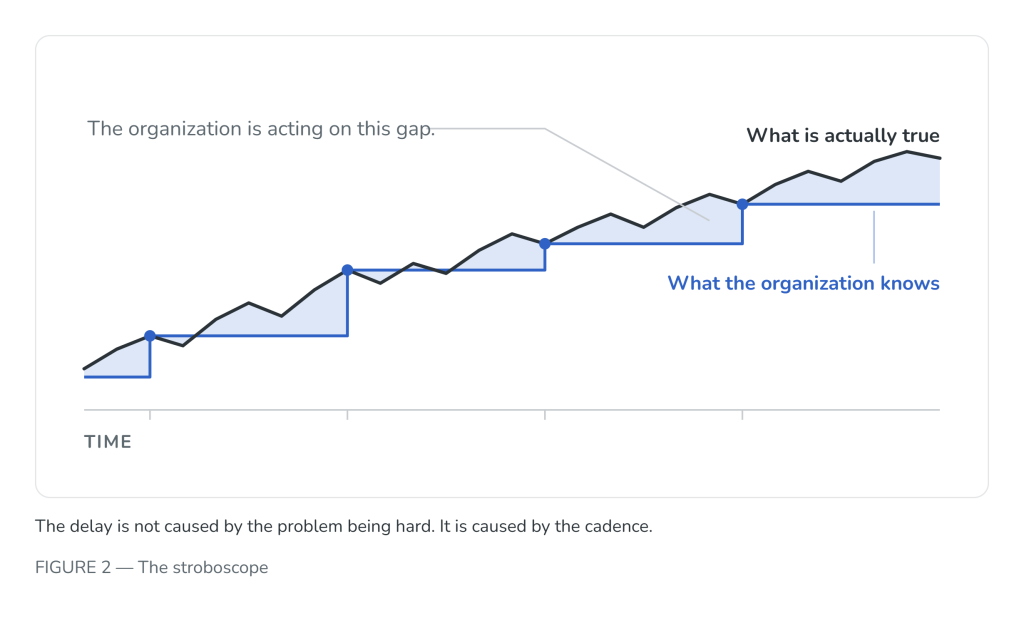
The latency cost. Because the picture is expensive to assemble, it is assembled on a cadence. The organization’s understanding of its own state is stroboscopic: sharp at intervals, dark between them. Work sits blocked not because nobody could unblock it, but because nobody with the authority knew, and the mechanism that would have told them runs monthly.
The epistemic cost. This is the expensive one, and it is nearly invisible. With no shared instrument, the first segment of every consequential meeting is spent establishing what is true. Not deciding — establishing. Whose figure is current. Whether that milestone slipped or was rebaselined. That argument produces nothing, and it is conducted by the most expensive people in the organization at the moment their attention is most concentrated. Worse, it often doesn’t conclude, and the decision gets made anyway on the balance of assertion, weighted by seniority.
That is the real cost of an unmeasured function: not slower decisions, but decisions made on the basis of who argued more confidently.
What can actually be computed
Set the vendor question aside and ask a narrower one: given a coordination record an organization already holds, what is calculable by arithmetic rather than inference?
More than most people assume, and the useful part needs no analytics engine.
Structural conflict. If work is recorded with dependencies and dates, a fixed set of contradictions becomes detectable by comparison rather than by noticing.
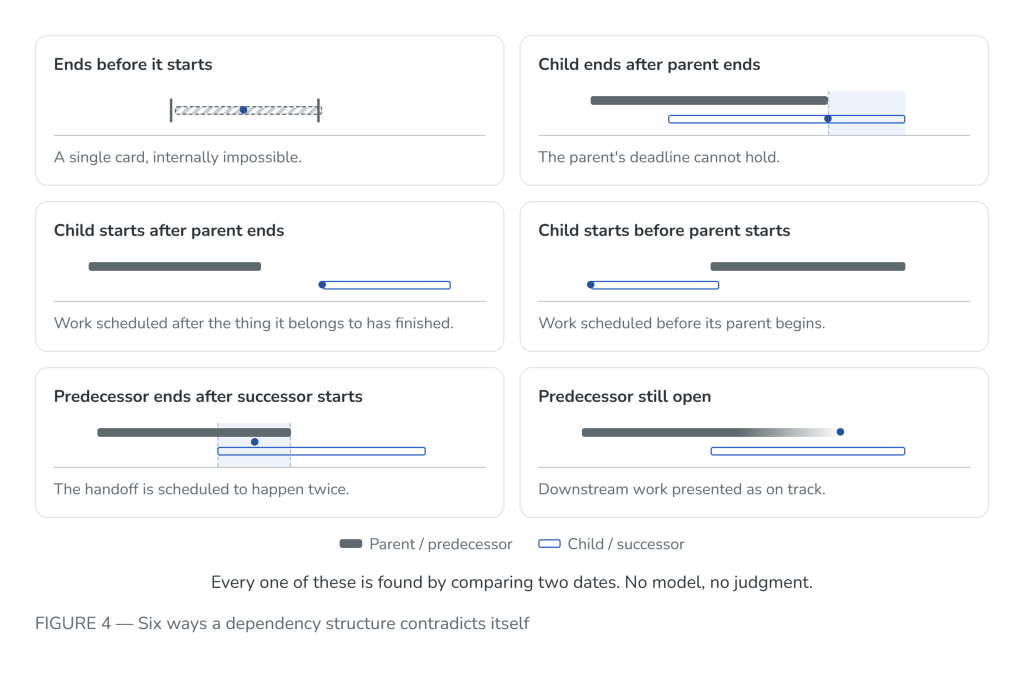
The important property is that this set is finite and enumerable. There is a bounded number of ways a dependency structure can be internally inconsistent. These conflicts sit in most large plans right now, and they are found today by an experienced person happening to notice — which is why they are found late.
Waiting. If a blocked item is a structured object with a reason and an owner, rather than a sentence in a status field, waiting becomes countable. How much work is waiting, on what, on whom, for how long. And in the other direction: if one constraint cleared, how much would move. That last calculation changes escalation from a claim about urgency into an arithmetic comparison.
Concentration. Coordination friction is never uniformly distributed. It gathers in a specific approval, a specific integration, a specific individual who is a single point of failure for a class of decision. Every organization has an oral tradition about where its bottlenecks are, and that tradition reflects who complains loudest rather than what holds the most work. The distribution is checkable. So is recurrence, once reasons are recorded in a shared vocabulary rather than free text — a repeated friction needs a structural fix, not another escalation.
Currency. The measurement that must come first and almost never happens: how recent is the record? Every calculation above inherits the freshness of its inputs. An organization whose people record work as they do it gets a live instrument. One whose people update the system before the review gets a fast, shared, confident, wrong picture — worse than none, because the confidence is unearned.
Note what is absent. No sentiment analysis, no productivity scoring, no inference about individuals from activity volume. Those are what get coordination measurement thrown out of a works council meeting, and rightly. What survives is arithmetic on facts the organization already has.
The condition
All of it rests on one thing, and it is not a capability anyone can sell.
The coordination has to happen in the record, not be described to it afterwards.
This is what made every other discipline work. Finance is measurable because the transaction and its record are the same event. When the record is instead a secondary account — entered later by someone who was in the room — it is incomplete, delayed, and shaped by what the recorder thought worth mentioning. Every calculation then runs on the retelling.
Which makes the useful question about any coordination measurement programme not which tool, but: when a dependency between two teams is agreed, does it come into existence in the record, or does someone write it down later?
If it is the second, the numbers will be confident and wrong.
The second obstacle, which nothing you buy will solve
Removing the external obstacle makes the measurement possible. It does not make it survivable.
If the record shows that one team’s dependency is holding fourteen work items, that is an indictment whether or not a vendor can see it. The leader who owns that team will contest the reason coding, the ownership, and the definition of waiting — and they will be right to, because a measurement that assigns blame without their agreement is a weapon pointed at them. The discipline does not fail in a data centre. It fails in a conference room where two leaders argue about whose vocabulary applies.
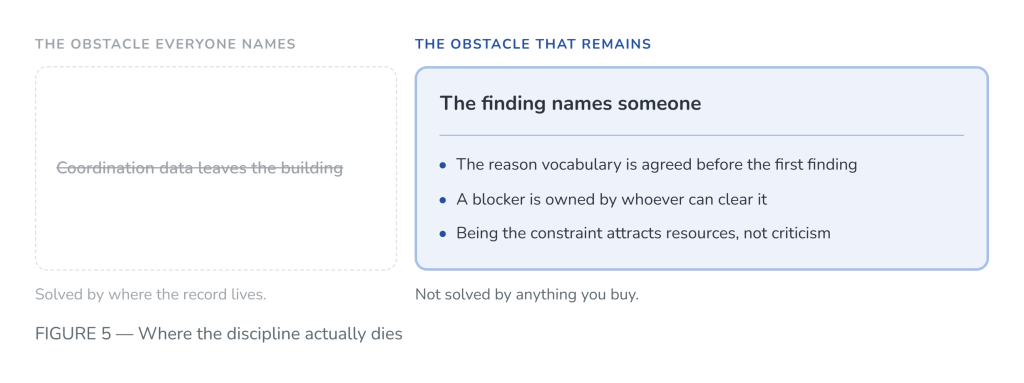
Three practices decide whether it survives, and all three have to be settled before the numbers exist.
Agree the reason vocabulary before it produces a finding. Whoever defines the categories after the first result controls what the result means. Defining them in advance, jointly, is the only version anybody accepts afterwards.
A blocker is owned by whoever can clear it, not by whoever is waiting. This single rule converts the measurement from an accusation into a statement about capacity, and it is the difference between a constraint being reported and a constraint being hidden.
Being identified as the constraint must attract resources, not criticism. This is the one that decides everything. If the organization’s response to appearing in the waiting data is scrutiny, the data is gamed within a quarter — reasons get miscoded, blockers go unrecorded, dependencies stop being declared — and every calculation upstream becomes worthless. It is the same failure as publishing individual activity, one level up, and it is how these programmes actually die.
None of this is a feature. It is a set of decisions an executive has to make and hold, and it is harder than any part of the installation.
Where KanBo sits in this
This is a KanBo publication, so the position should be stated rather than smuggled in.
KanBo is a coordination record that lives inside the customer’s own environment. Its dependencies, blockers, statuses, and conflict detection exist to make coordination recordable as it happens rather than describable afterwards. The calculations run against the customer’s own data, in their environment. Nothing is exported, and the coordination map does not leave the building — which is the only arrangement under which the institutions with the most coordination complexity will record coordination at all.
The consequence we would rather state than write around: we cannot tell you how our customers coordinate. We do not hold that data. This article contains no aggregate statistics for exactly that reason. It means we cannot offer benchmarks, and when a prospect asks what good looks like across their industry, the honest answer is that we don’t know, because knowing would require an arrangement we deliberately do not have.
We think that trade is correct. An industry benchmark bought at the price of every participant exporting their dependency structure is not a good deal for the participants — and a vendor holding the coordination map of a few hundred institutions is the arrangement that kept this function unmeasured for twenty years. So the numbers will come from organizations measuring themselves and choosing what to say. That is slower, and it is the only version the organizations with the most at stake will join.
Where to start
- Pick the unit and hold it. Most likely the dependency: a recorded relationship between two pieces of work owned by different people. Consistency beats correctness.
- Move dependency creation into the record. The moment two teams agree a handoff, it exists as an object with an owner on both sides. Until this is true, nothing downstream is worth computing.
- Measure currency before anything else. If the record is weeks stale, stop and fix that. Every other measurement is invalid until this one is acceptable.
- Run conflict detection and expect the first result to be embarrassing. Most large plans contain contradictions nobody has compared. That is not a crisis; it is the baseline you didn’t have.
- Settle the politics before the first finding. Agree the reason vocabulary jointly, put blocker ownership with whoever can clear it, publish where work waits rather than what individuals did — and make appearing in that data a route to resources. Do this after the numbers exist and it will read as a defence of a result somebody already dislikes.
The claim
Coordination is not unmeasurable. It is unmeasured — a different word with a different implication.
The obstacle was never mathematics. Comparing dates, counting waiting, grouping reasons: the arithmetic is trivial. The obstacle was that capturing coordination meant handing an organization’s internal power map to a third party, and the institutions with the most at stake correctly refused.
Remove that condition and the discipline becomes available — available, not automatic. What remains is a practice, and most of it is not technical: record coordination as it happens, in an environment you control, agree what the categories mean before they produce a finding, make being the constraint a reason to receive help, and stop beginning your most expensive meetings by arguing about whose numbers are current.
This function will get its measurement discipline eventually, the way finance and manufacturing got theirs. The open question is whether it arrives as something organizations own, or something they rent and export.